
How to Teach Your Dog to Settle on a Mat
To teach a dog to settle on a mat, start in a quiet room, reward voluntary interest in a comfortable mat, then quietly reward signs of relaxation. Build time in tiny increments before adding distance or distractions. Going to a designated place and feeling relaxed there are different skills: a motionless dog can still be worried or waiting intensely for the next treat.
Rest is the goal, not a rigid pose. Illustrative photo of Coco by Slyronit, CC BY-SA 4.0, reused without further editing. This is not a documented mat-training session.
Place versus settle: what are you actually teaching?
Place means moving onto a particular surface and, once taught, remaining there until released. Settle means becoming comfortable enough to rest, rather than holding a position under pressure. You can teach both, but a successful “place” response does not prove the dog feels calm.
Look for several signs together: muscles becoming less tense, a comfortable weight shift, softer eyes, looking away from you, and perhaps resting the head. Compare these with your dog's normal behavior and the surroundings. A single sigh, yawn, head-down posture, or refusal to move is not a reliable emotional diagnosis.
A stiff dog staring at a visitor, panting when not hot, repeatedly scanning the room, or trying to leave needs more space or an easier situation—not a longer stay. Our dog body language guide explains why context matters.
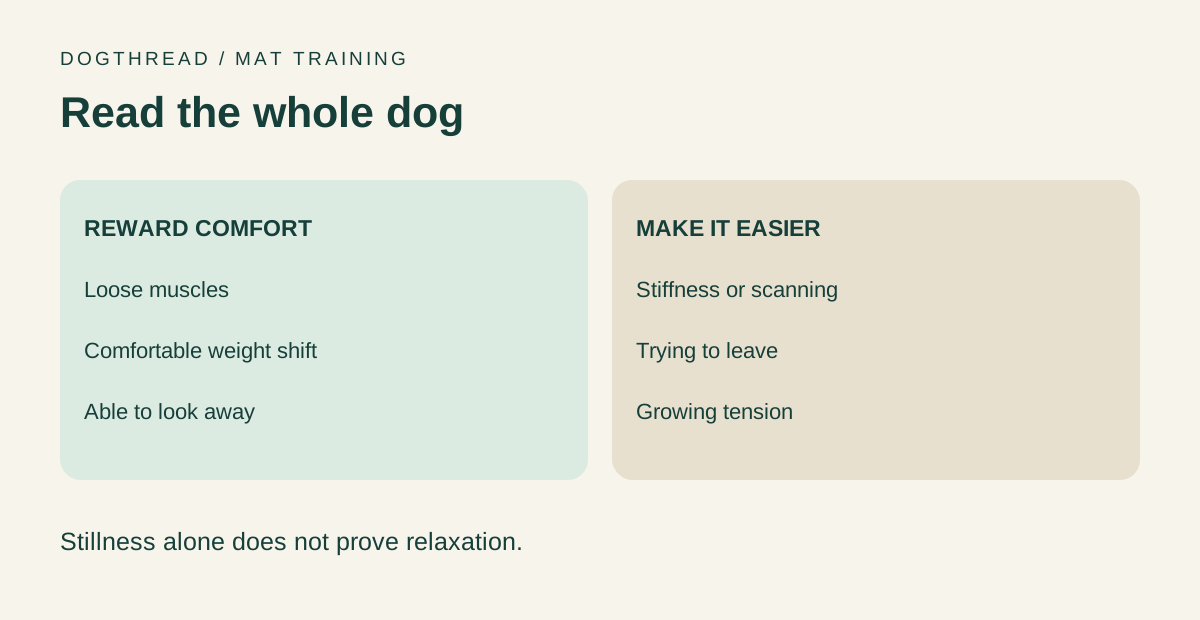
Read the whole dog. Stillness alone is not proof of relaxation.
Set up a space where resting is possible
You need:
- A non-slip mat or blanket big enough for your dog to lie comfortably on their side. Add appropriate padding for a dog who finds hard floors uncomfortable.
- Tiny, easy-to-eat rewards your dog likes and can safely eat. Count them toward daily food intake.
- A quiet room, a chair, and a few uninterrupted minutes.
- Optionally, a familiar reward marker such as a quiet “yes.” A clicker is not essential.
Start after a toilet opportunity and appropriate activity, when your dog is neither frantic nor exhausted. Sniffing and easy enrichment may help meet their needs; trying to wear a dog out is not a substitute for teaching rest.
Put the mat away from doorways and household traffic. Keep water accessible. Separate other animals if food could cause competition. Supervise dogs who chew bedding, and change the surface if they try to swallow it.
A secure room lets the dog move away freely. If a lead is needed for safety, keep it slack and supervise; do not tether the dog to the mat or use lead pressure to hold them down.
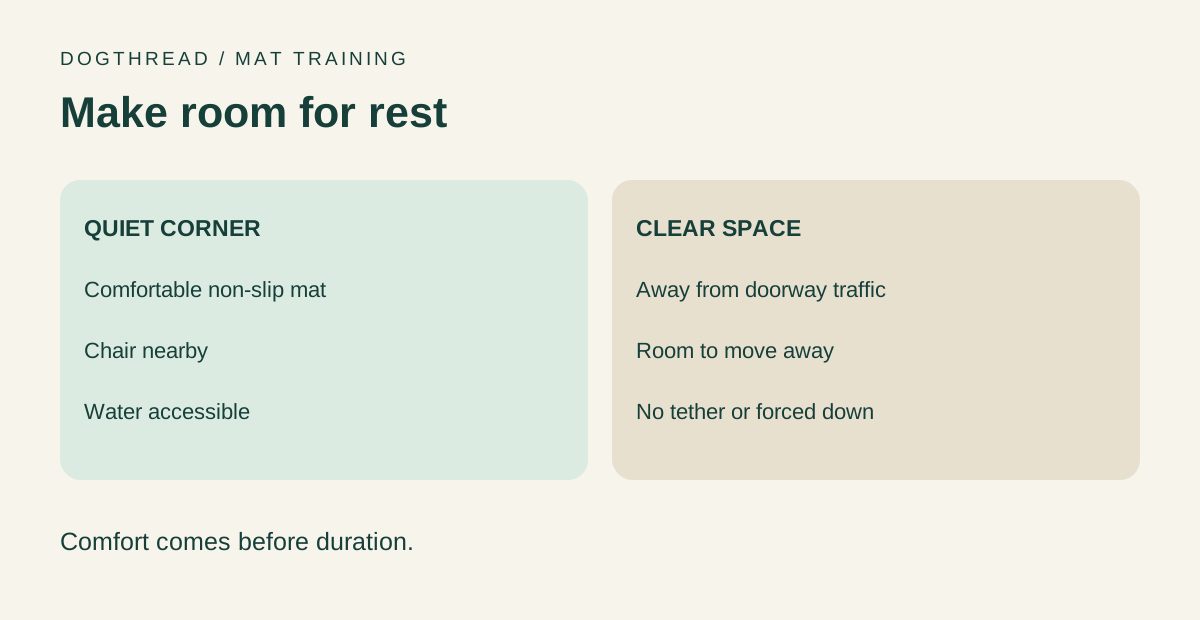
Choose comfort and a clear exit, not a spot where people must step over the dog.
Step 1: make the mat worth approaching
Put the mat down and wait. Quietly mark a glance, sniff, or paw on it, then deliver a small reward onto the mat. As your dog understands the game, reward stepping farther on. Work toward all four paws without pushing, pulling, or repeatedly issuing commands.
A brief food lure is an option for a confident dog, but fade the visible food prompt quickly. Do not lure a worried dog into a place they are reluctant to enter. Change the surface or location instead.
Keep this introductory game short—perhaps a minute or two, stopping sooner if interest fades. These are starting examples, not targets every dog must meet. Finish while the experience is still easy.
Step 2: add a release and a comfortable down
In short place-training repetitions, say a release word such as “free,” then invite your dog off the mat. Initially, a small treat tossed nearby after the word can explain that movement is allowed. Avoid making an exciting chase game of it.
When your dog returns, reward on the mat. If they already understand “down,” you can ask once or use a gentle hand signal. Otherwise, reward a voluntarily offered down or teach lying down separately. Do not physically fold their legs, press their shoulders, or insist on a posture that appears uncomfortable.
The release cue marks the end of a training repetition; it is not permission to ignore distress until you release them. If your dog leaves early, do not correct or drag them back. Check why, then make the next repetition shorter or easier.
Once approaching the mat is predictable, say “mat” just before the movement you expect, then reward it. If the cue produces uncertainty, return to easy repetitions rather than repeating it louder. The word labels going to the mat; it cannot command an emotional state.
Step 3: quietly reward actual settling
Now shift from the approach game to a low-key rest opportunity. Sit nearby, soften your own movements, and stop asking for a string of tricks. Reward small changes toward comfort: looking away from your hand, shifting onto a hip, or lowering the head with otherwise loose body language.
If a quiet marker helps, use it at the moment you notice the behavior and deliver the food low on the mat. If any marker makes your dog spring up, simply place the reward gently within reach. Do not hold food above their head or make them stand to collect it.
A dog staring at your treat pouch is engaged in training, but may not be relaxing. Put the food out of sight, reduce your attention, and reward a brief disengagement. If they remain frustrated or cannot disengage, finish and reconsider their needs and the setup. Do not turn this into a contest of who can wait longest.
You can also notice and gently reward spontaneous resting outside formal sessions. Do not wake a sleeping dog to pay them for sleeping.
Step 4: build duration without creating a test
When your dog is comfortable between rewards, lengthen one gap by a second or two. Mix in easier, shorter gaps instead of making every repetition harder. For example, a dog already comfortable at two seconds might practice two, three, then two seconds—not jump straight to a minute.
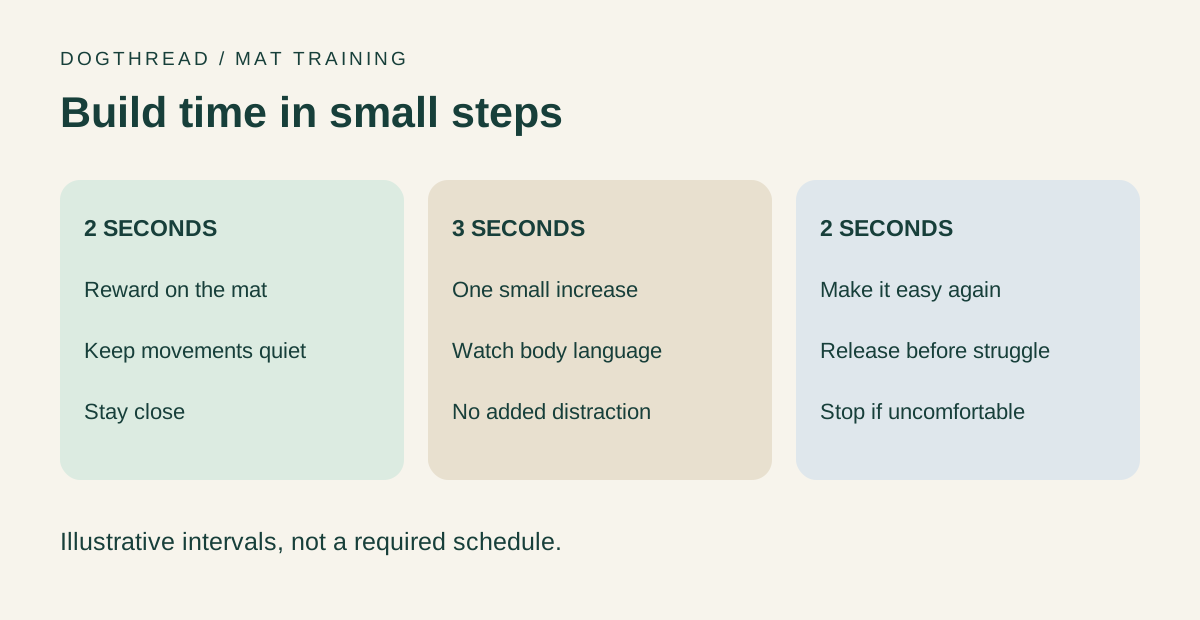
These intervals illustrate small changes. Follow your dog, not a stopwatch target.
Stay nearby and keep the surroundings quiet while adding time. Reward where the dog is resting. Use the release cue before they struggle during formal practice; if they are happily resting afterward, there is no need to make them get up.
Over repeated successful sessions, food can become less frequent. Do not abruptly remove all reinforcement or expect a long wait just because yesterday went well. Success is increasingly easy rest, not a dog enduring a timer. There is no universal number of days to finish mat training.
Step 5: change only one difficulty at a time
The three variables are duration, distance, and distraction. Increase one while making the other two easy.
| Variable | Small first change | Keep easy | | --- | --- | --- | | Duration | A slightly longer pause before food | Sit nearby in a quiet room | | Distance | Shift your weight or take half a step away, then return | Reward promptly; no added noise | | Distraction | A helper moves quietly far away | Stay close; keep the repetition brief |
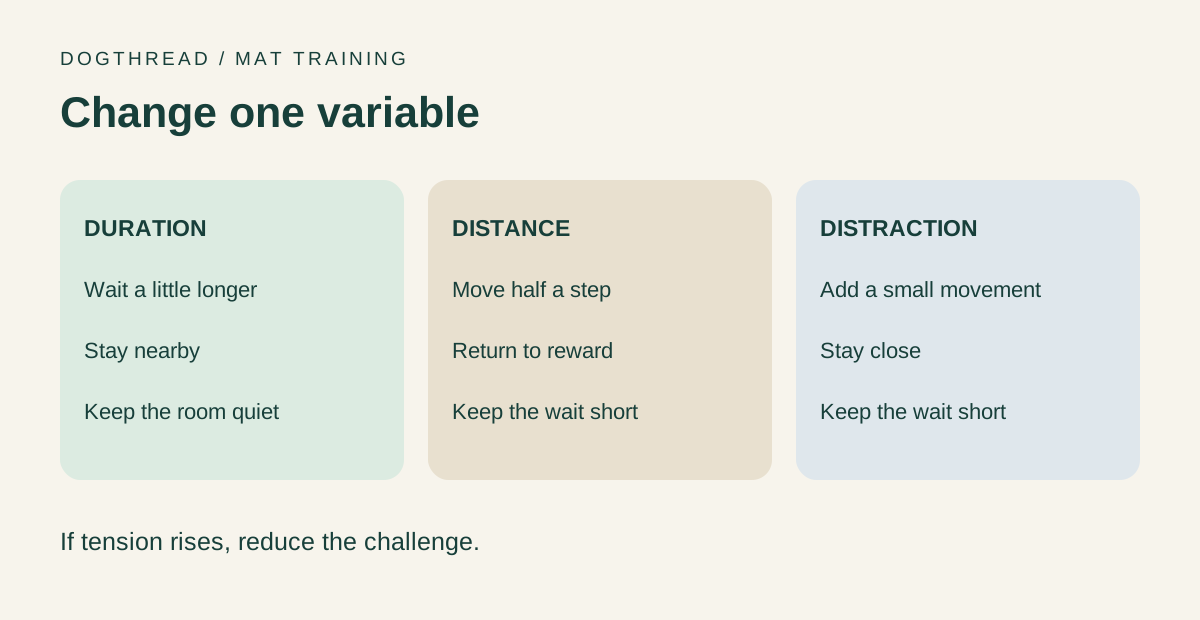
Walking away while someone rings the bell increases two challenges at once.
For distance, return to the dog to reward instead of calling them off the mat. Separately practice sending them to the mat from slightly farther away. For distractions, start with an uneventful movement—not a visitor's arrival or a loud doorbell.
If your dog gets up, calmly reset only if they want to continue. If they become tense, stare, bark, or cannot return to comfortable behavior, remove or reduce the distraction. Repeated difficulty means the setup needs changing, not that the dog is being stubborn.
Practice in another quiet room before trying a busy setting. A familiar mat can help provide continuity, but dogs do not automatically transfer a skill everywhere.
Use the mat with visitors and when traveling
Rehearse with one calm helper before expecting success at a gathering. Place the mat well away from the entrance. Ask the helper to ignore the dog: no reaching, looming, or calling them over. Begin with the helper seated at a comfortable distance; add movement only after that is easy.
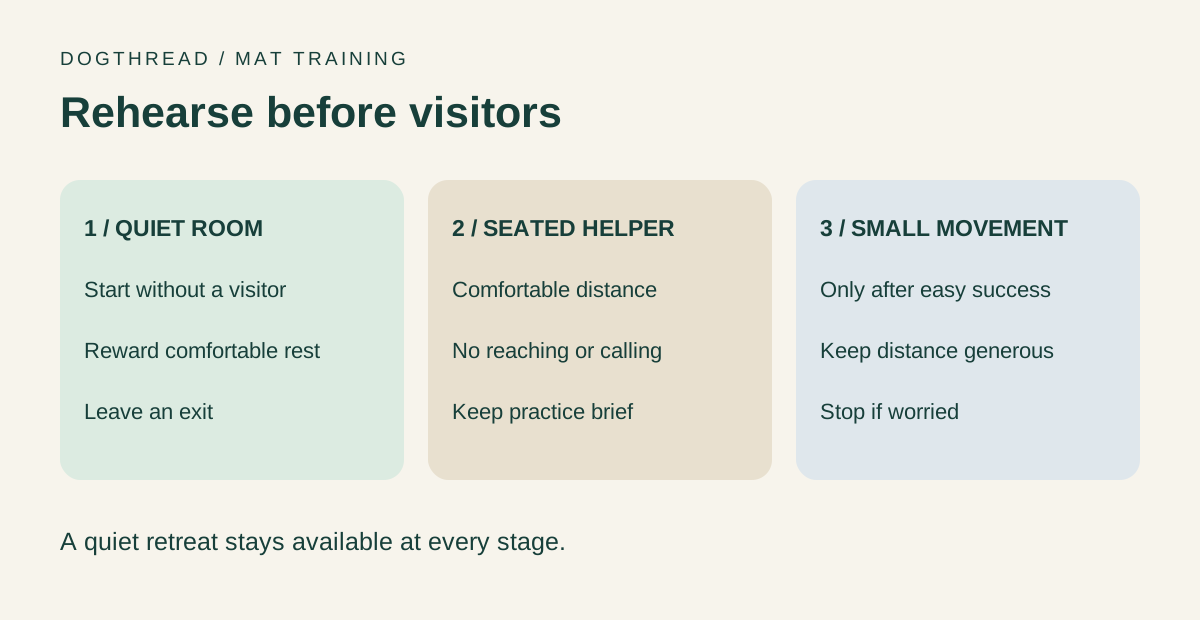
The dog should have a retreat. A mat is not a way to make them tolerate unwanted contact.
During real arrivals, use suitable management—a comfortable separate room or a familiar barrier, if your dog is happy with it. Then offer a brief practice when the house is quieter. Our calm-greetings guide covers greeting rewards; settling is the separate skill of resting away from the interaction. Children and visitors should leave a resting dog alone.
For travel, introduce the mat in a quiet part of the new accommodation before expecting it to work at a café. Choose low-traffic, dog-permitted spaces, provide water and breaks, and leave if your dog cannot get comfortable. The mat is not a restraint system for car travel and does not replace appropriate vehicle safety equipment.
Common problems and humane fixes
“My dog keeps hopping off.” Shorten the repetition, check that the mat does not slide, and reduce nearby activity. Leaving gives you information. Rewarding every rapid on-off cycle can accidentally create a hopping game; make the next attempt easy enough to reward a brief pause on the mat.
“My dog lies down but watches me intensely.” Stop running a rapid cue-and-treat drill. Reward small, comfortable disengagements with low delivery and less attention. Do not assume a perfectly held down is relaxation.
“My dog barks when food stops.” The gaps may have increased too quickly, or the session may be too stimulating. End calmly, check needs, and restart later with easier expectations. Do not punish barking or withhold food indefinitely to force silence.
“It works at home, not outside.” The environment changed. Start again with brief, well-supported practice in a quieter location. A crowded café is not the next logical step after the living room.
“My dog chews the mat.” Stop if ingestion is possible. Try an appropriate sturdier surface under supervision and consider whether your dog needs a safe chewing outlet or a break. Do not leave an unsafe mat available.
When mat training is not the answer
Pain, physical discomfort, unmet needs, fear, and separation-related distress can all interfere with rest. Seek veterinary advice for a new or persistent inability to settle, especially with stiffness, unusual panting, sleep changes, or difficulty lying down. Labored breathing, collapse, or obvious severe pain warrants urgent veterinary care.
If your dog panics when you leave, do not use an out-of-sight mat stay to test how long they can cope. Mat training alone is not treatment for separation problems. Ask your veterinarian and a suitably qualified, reward-based behavior professional for an individualized plan.
Stop sessions involving freezing, repeated escape attempts, growling, or escalating distress. Give space; do not punish warnings or keep exposing the dog until they “give in.” A professional can help distinguish a training gap from a welfare problem.
FAQ
Does my dog need a place cue to learn to settle?
No. You can reward spontaneous comfortable resting on a mat without a verbal cue. A place cue is useful when you want to direct the dog to that location, but relaxation is a separate goal.
Should I use a clicker for mat training?
Only if it helps your dog. A familiar clicker can mark approaching the mat accurately; quiet food delivery may be better during relaxation if clicking makes the dog jump up.
How long should my dog stay on the mat?
Start with a duration your dog can manage comfortably, even if that is only a moment. Build gradually with breaks. There is no universal stay length, and a mat should never replace exercise, toilet opportunities, social contact, or comfortable sleep.
Can I use a dog bed instead of a mat?
Yes. Choose a comfortable, stable surface large enough for natural resting positions. A portable mat is convenient for new places, but comfort matters more than portability.
Sources and approach
This is an editorial synthesis, not a report of hands-on training or veterinary assessment. It combines Dogs Trust's settle-training guidance on rewarding relaxed behavior with the American Kennel Club's place-training guide on shaping the location behavior, release cues, and changing one difficulty at a time. Both were consulted October 28, 2026. Timing examples are illustrative, not validated schedules. Supporting diagrams are original Dogthread editorial illustrations, not photographs or evidence of training outcomes.