
Best Dog Car Restraints: How to Read Crash-Test Claims Before You Buy
Photo: Dietmar Rabich / Wikimedia Commons, “Dülmen, Hausdülmen, Golden Retriever -- 2022 -- 5945” / CC BY-SA 4.0. Resized editorial photo; not a product-test participant.
The best dog car restraint is one with documented crash-performance evidence for the exact model and configuration, a correct fit for your dog, and an installation your vehicle actually supports. “Crash tested” alone does not tell you whether a product passed, which size was tested, or what happened to the test dummy.
Start with a current independent listing, then check the manufacturer's sizing and installation instructions. Our document-based shortlist covers the Sleepypod Clickit Range harness, Sleepypod Air carrier, and Gunner G1 Intermediate kennel with strength-rated anchor straps. These are three options to investigate—not a claim that one setup is safest for every dog.
Evidence checked October 31, 2026. We did not buy, fit, drive with, or crash-test these products. Product links below are direct source links, not affiliate tracking links. Certification is evidence under specified test conditions, not a promise of injury prevention or survival.
Read the crash-test claim before the ranking
Use this evidence hierarchy when comparing a dog seat belt harness, carrier, or crate:
| Evidence you can inspect | What it helps establish | What it does not establish | | --- | --- | --- | | Current independent certification entry for the exact model and size/configuration | A published pass/rating against an identified protocol, with the listed scope | Protection in every collision or suitability for your particular dog | | Manufacturer-funded laboratory report with identifiable setup, protocol and results | What was tested and the measured outcome, if fully disclosed | Independent certification merely because an outside lab performed the test | | Manufacturer video or “crash tested” statement without a complete report | That a test is claimed or shown | A pass, defined acceptance criteria, or applicability to every variant | | Reviews, testimonials, “heavy duty” labels and star ratings from shoppers | Owner experiences and usability impressions | Crashworthiness |
The Center for Pet Safety certification program is voluntary. CPS says participation involves independently developed standards, quality-control monitoring and truth in marketing. It is not a government approval label.
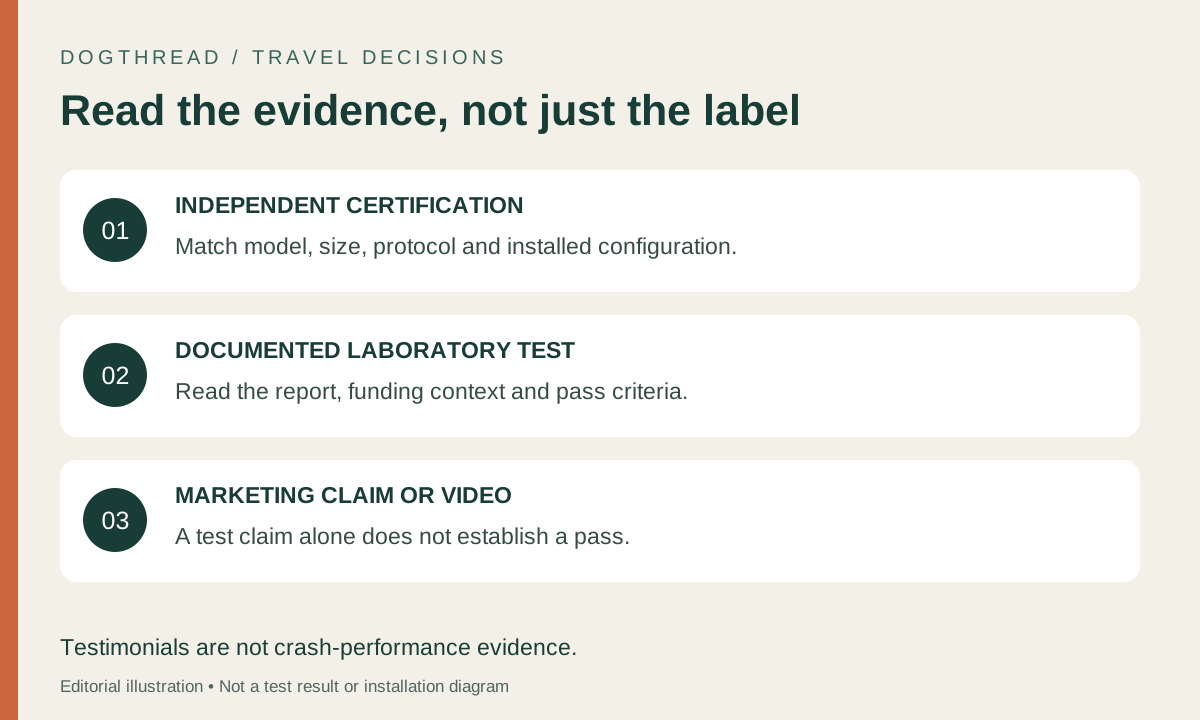
Editorial decision aid, not a certification mark or test result.
Read beyond the number of stars. Ask for the test date, protocol, exact model and size, test-dummy mass, attachment hardware, pass criteria and video/report. Check whether the dummy remained restrained and what forward movement was allowed. CPS's 2013 harness research discusses hardware, stitching, connection points, excursion and keeping the dummy on the seat. Those are more informative than a dramatic slow-motion clip.
A static pull test of a buckle is not the same as a dynamic crash test of the whole installed restraint. Similarly, a reference to child-seat standards does not turn a pet harness into a government-approved child restraint. Ask which parts of a protocol were used and what passed. CPS uses weighted simulants, not live dogs, in its crash tests.
Historical research can explain failure modes; it should not be used to declare an untested redesign a failure—or a success. Always return to the current model's documentation.
A walking harness is not automatically a crash restraint
A walking harness manages leash forces and everyday movement. A crash-restraint system must also manage a very different loading event, including the connections between the dog, harness and vehicle. Padding, a metal clip and the words “seat belt compatible” do not establish that performance.
Some documented car harnesses can also be used for walking. The reverse does not follow: a good walking harness plus a generic buckle tether is not automatically a tested car-restraint system. Our small-dog walking-harness guide addresses a different job.
Do not attach a vehicle restraint to a neck collar. Do not add extension straps, ziplines, carabiners or buckle adapters unless the restraint maker explicitly approves that exact configuration. Additional slack changes how far a dog can move; CPS specifically flags extension tethers and zipline-style products in its harness research.
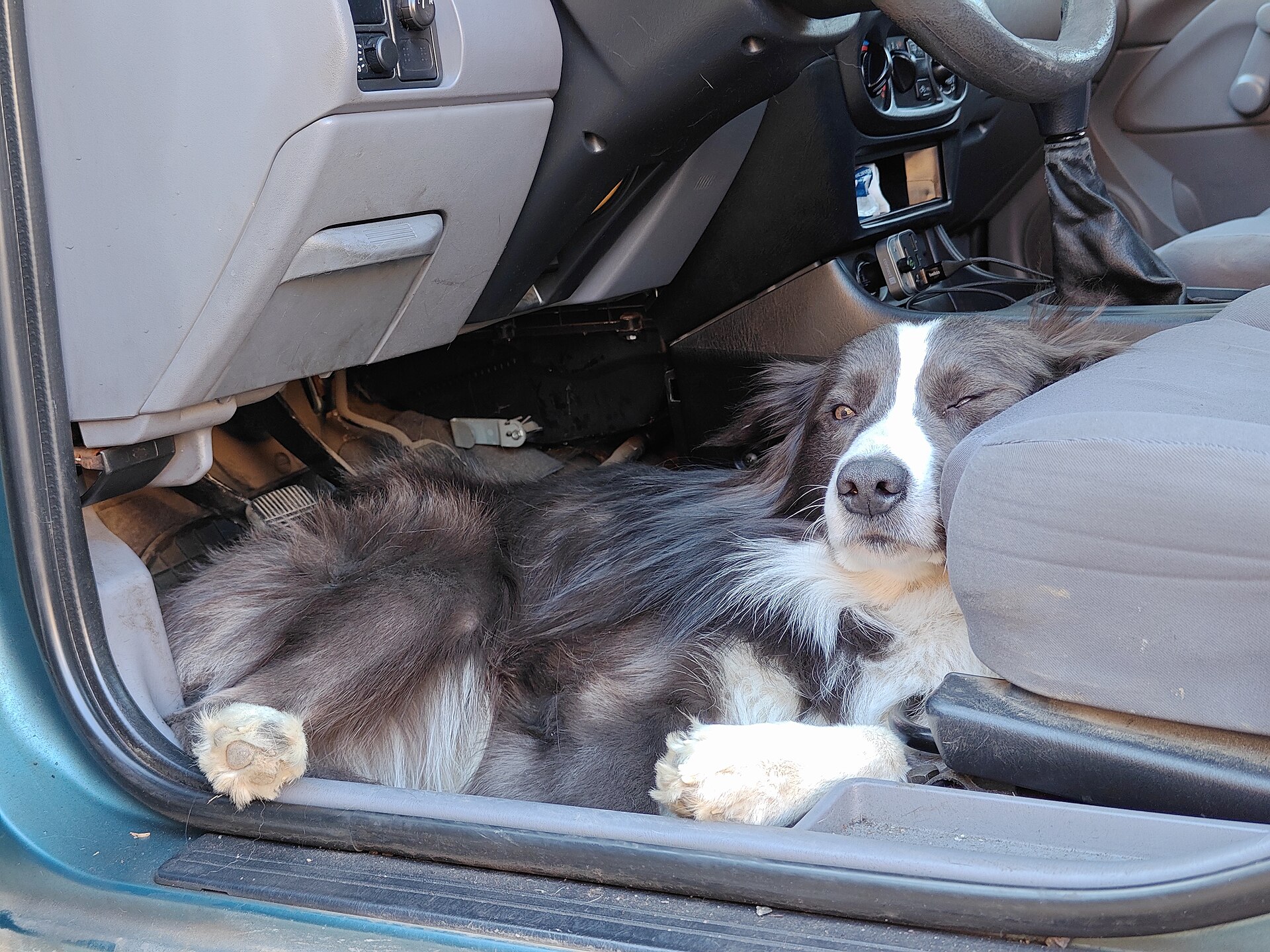
This is not a safe driving position: keep dogs away from pedals and the driver's controls. The photo does not demonstrate a restraint installation. Kryštof Jelínek / Wikimedia Commons, CC0; resized.
Three currently documented options—and their limits
These records were accessible in the current CPS directory on the check date. A historical test date can appear in a current listing; it does not mean the product was retested this year. Availability, price and every current retail variant were not independently confirmed, so this is not an in-stock shopping list.
| Option | Independent record checked | Published fit information | Who should consider it—and who should skip it | | --- | --- | --- | --- | | Sleepypod Clickit Range | CPS listing: 5 stars; November 2024; protocol CPS-001-014.01; test dog 110 lb; sizes S, M, L, XL listed | Manufacturer describes Regular and Long fits for dogs 18–110 lb and rear-passenger-seat use | Consider for a dog that accepts harness handling and fits an explicitly covered size. Skip below the maker's stated range, with unresolved size coverage, or when the prescribed belt routing is incompatible with your seat. | | Sleepypod Air | CPS listing: 4 stars, not five; January 2025; protocol CPS-001-016.02; one size; test dog 18 lb | Manufacturer: pets 18 lb or less; interior 15–21 × 9.5 × 9.5 inches, depending on configuration | Consider for a small dog that fits the interior and settles in an enclosed carrier. Skip if the dog is too tall/long, exceeds the limit, persistently chews the enclosure, or cannot tolerate it without distress. | | Gunner G1 Intermediate with strength-rated anchor straps | CPS listing: 5 stars; June 2015; protocol CPS-002-016.01; test dog 75 lb | Manufacturer: Intermediate exterior 34 × 23 × 28.5 inches; 30 inches high with handles | Consider for a crate-comfortable dog and a vehicle with enough space and suitable anchoring. Skip if the secured kennel blocks safe access, the required anchors are absent, or the dog's measurements do not fit. |
Clickit Range: resolve the size-list mismatch
The manufacturer's current page includes 2XL in its dimensions and describes Regular and Long versions. The CPS entry we checked lists Small through XL and a 110 lb test dog. Do not assume that every retail variation is covered solely because it shares the Range name. Get confirmation of the exact version and size from the manufacturer/CPS if the listing does not clearly match your purchase.
The same principle applies to fit: the stated weight range is not a substitute for the maker's measurement process. A deep chest, narrow torso, barrel chest or thick coat may change the fit decision. Breed examples are starting points, not measurements.
Sleepypod Air: distinguish carrier configuration from airline marketing
The published interior length varies because the carrier compresses. Check the correct vehicle-use configuration and belt-routing instructions; do not assume that the compressed airline setup is the car setup. Airline acceptance is a separate question from crash performance, and the actual airline still sets its requirements.
The four-star CPS entry is the rating used here, even though a sales description uses broad language such as “top safety rating.” Check that the current design you buy matches the documented version.
Gunner Intermediate: a 75 lb test dummy is not a sizing recommendation
The current product page labels Intermediate “up to 70 lbs” but also includes breed-fit wording referring to dogs up to 75 lb. The CPS test mass is 75 lb. These are different statements, and the sales-page wording is not fully consistent.
Do not resolve that discrepancy by picking the highest number. Ask Gunner to confirm fit from your dog's measurements and the current sizing guidance. Exterior measurements tell you whether the kennel might fit the car—not whether the dog fits inside it. The certification names strength-rated anchor straps; an unsecured kennel or improvised tie-down system is not the configuration represented by that record. Nor should this Intermediate result be transferred to a different kennel size.
Match the dog, the restraint and the vehicle
Before buying, run three separate fit checks:
- Dog fit: weigh and measure the dog using the exact product's instructions. For harnesses, check required chest/body measurements and adjustment range. For carriers/crates, check usable internal dimensions and the maker's travel-fit criteria. Recheck growing puppies and dogs whose weight changes.
- Vehicle fit: measure the available seat or cargo space, opening clearance and access to buckles or approved anchors. Read the vehicle manual as well as the restraint manual. Do not assume a luggage hook, child-seat anchor or seat-belt extender is approved for your pet setup.
- Installed fit: with the vehicle parked, follow the current manual exactly, close every required fastener and verify that the dog cannot escape the fitted system. Confirm belt routing, strap tension, ventilation and access for unloading. If instructions conflict or the fit is unclear, stop and get the maker's guidance.
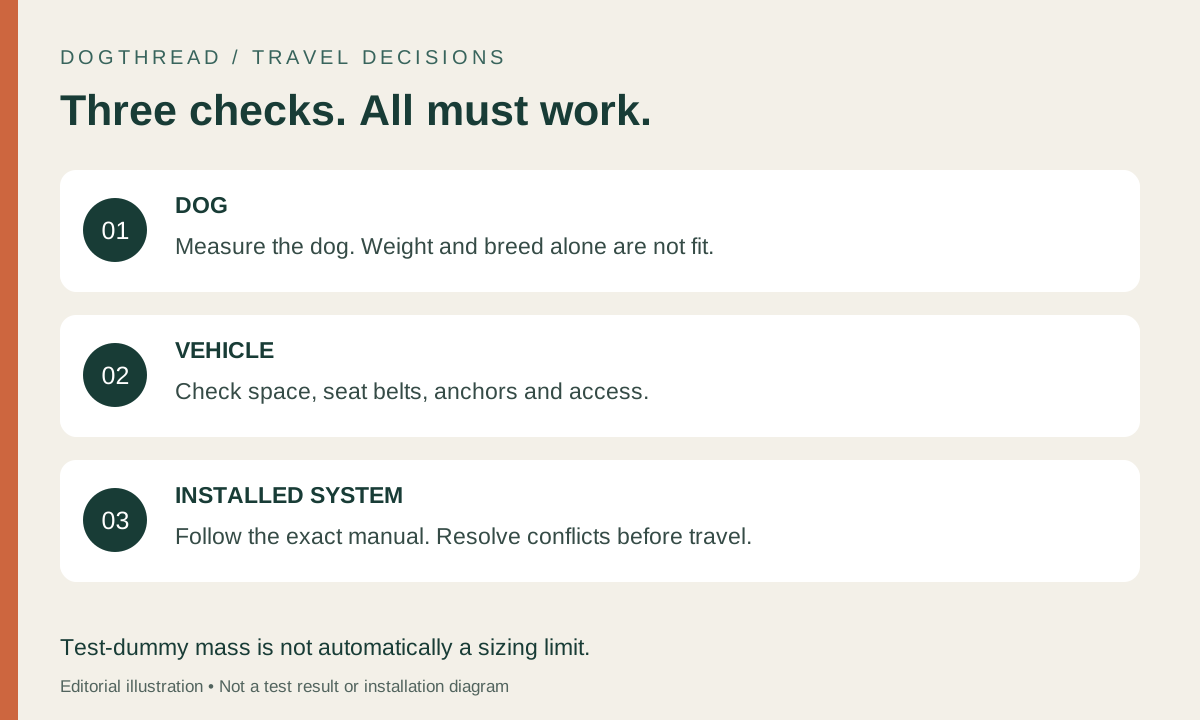
All three checks must work; a certification rating cannot compensate for a mismatched installation.
A product claiming broad vehicle compatibility is not proof it works with your specific seat geometry or belt arrangement. Avoid the front passenger seat and airbag zone; follow the product's approved seating location. Do not let a secured dog share space with unsecured heavy luggage.
For a dog with spinal disease, recent surgery, breathing problems or pain when handled, ask your veterinarian which posture and restraint type are appropriate before choosing gear. That is a medical-fit question this comparison cannot answer.
Harness versus carrier versus crate: choose the setup you can use correctly
A harness usually uses less space than a rigid kennel, but correct adjustment and belt routing are essential on every trip. It is a poor choice if your dog repeatedly escapes, chews the straps or cannot tolerate the supported posture. A harness should not be loosened into ineffectiveness to make a distressed dog accept it.
A carrier can suit a genuinely small dog and provide a familiar enclosed space. Interior dimensions, ventilation and secure closure matter as much as the weight label. It is not a workaround for a dog that is too large to fit or panics inside it.
A crate/kennel can suit a dog already comfortable with confinement and an owner with sufficient vehicle space. Its bulk, lifting demands and anchoring requirements are real tradeoffs. A household wire crate or an airline label alone does not establish vehicle crash performance.
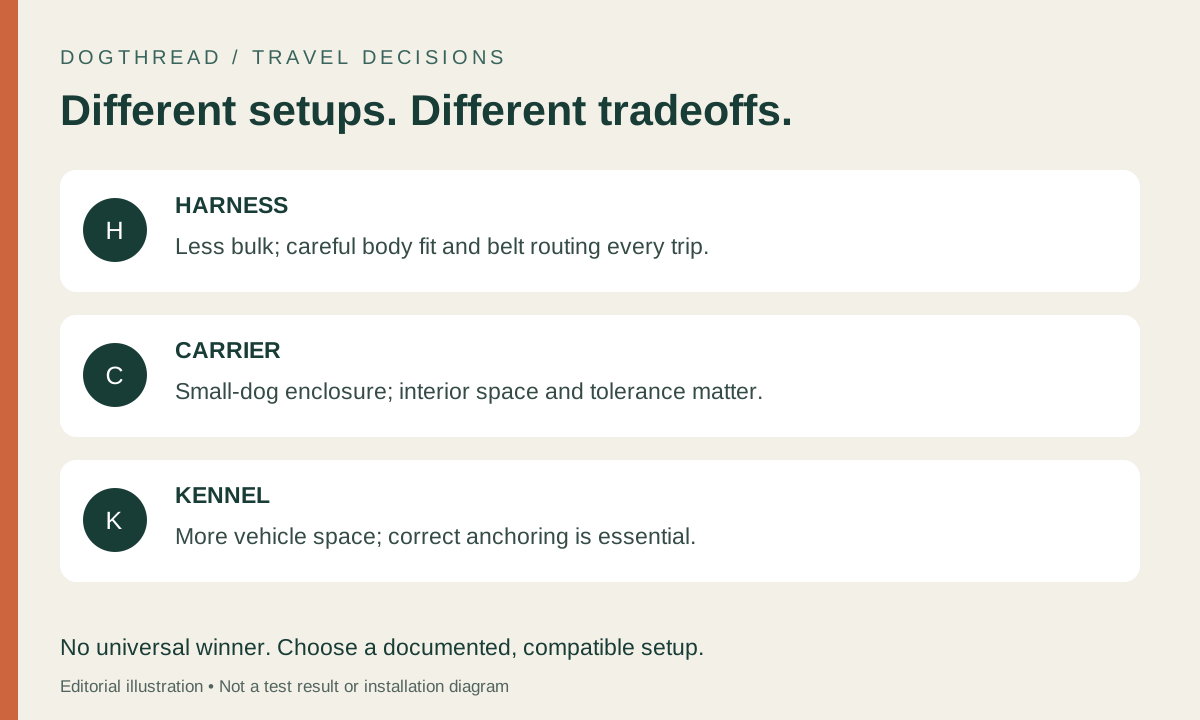
Compare requirements, not imagined universal winners. Ratings from different product protocols are not a head-to-head injury-risk ranking.
Introduce the setup gradually in a parked vehicle, reward calm participation, then build toward short trips. Use our crate-training guide for positive confinement foundations and body-language guide to recognize discomfort. Persistent panic, vomiting or motion sickness calls for veterinary advice, not simply tighter restraints. Never leave a dog unattended in a hot vehicle; a carrier or insulated kennel does not make that safe.
Inspect it before trips—and after any collision
Look for cut or frayed webbing, chewed fabric or mesh, broken stitching, cracks, bent hardware, damaged latches and closures that no longer work reliably. Check the attachment points and whether adjustments have slipped. Stop using damaged equipment; do not patch a structural strap or substitute hardware and assume the original test result still applies.
After a collision, remove the restraint from service pending manufacturer guidance or replacement, even if it looks intact. Tell the manufacturer what happened and follow its replacement instructions; visible inspection cannot rule out all damage. Seek veterinary assessment for the dog after a crash, including when injuries are not obvious.
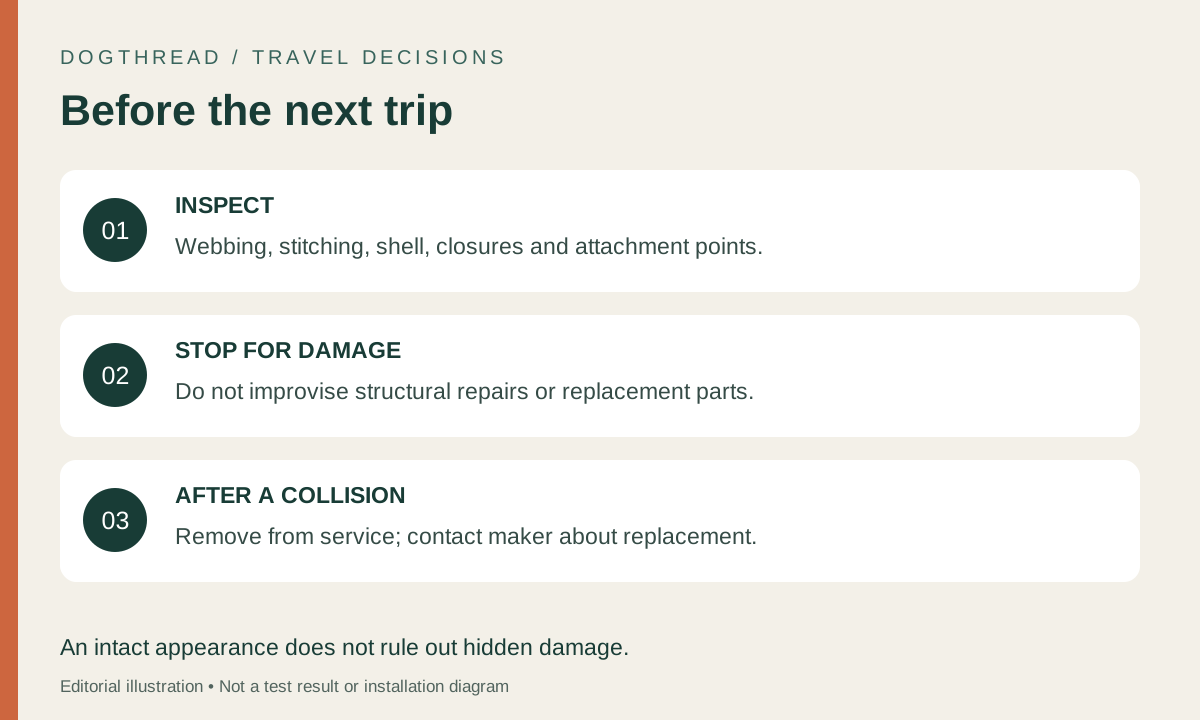
Keep the model, serial details if supplied, purchase record and installation manual where you can find them.
Sleepypod's Crash Replacement Program says restraint integrity may be compromised in an accident and offers potential free or discounted replacement subject to its terms and documentation. Shipping is excluded. Do not assume eligibility or extend that program to another brand. For any maker, check the current policy before purchase, including what evidence you must retain.
Unknown crash history is also a reason to be cautious about secondhand safety equipment. A lower purchase price does not resolve missing history, a missing manual or incompatible replacement parts.
Frequently asked questions
Does “crash tested” mean CPS certified?
No. It may describe a manufacturer's own test or an outside laboratory test without CPS certification. Look up the exact product in the current independent directory and compare model, size and installation details.
Is a five-star harness safer than a four-star carrier?
You cannot infer that from the stars alone. Harnesses and carriers use different test protocols and serve different dogs and installations. Compare each rating within its documented scope, then check fit and compatibility.
Can I use a walking harness with a dog seat belt clip?
Do not treat that combination as a crash restraint unless the exact harness and connection system have relevant documented evidence and are installed as instructed. A leash attachment point is not automatically a vehicle-restraint connection point.
What if my dog is heavier than the test weight?
Do not extrapolate from the test weight or assume a larger retail size has the same coverage. Check both the independent listing and the manufacturer's approved size/weight guidance. If coverage remains unclear, choose another documented setup rather than relying on guesswork.
Is a certified crate safe without tie-down straps?
A certification for a strapped installation does not cover an unsecured crate by implication. Use the exact approved anchoring system and verify the vehicle's anchor suitability. If you cannot install that system, it is not the right purchase for that vehicle.
How we researched this guide
This is an editorial comparison of publicly accessible CPS records and manufacturer documentation, checked October 31, 2026—not hands-on testing, veterinary advice or a laboratory assessment. We selected one harness, one small-pet carrier and one kennel to make their different requirements concrete. The shortlist is not exhaustive and does not declare unlisted products failures.
CPS entries are the source for certification ratings, protocols, dates and test masses. Manufacturer pages are the source for published dimensions, fit claims and replacement terms. We explicitly retained discrepancies instead of filling gaps with assumptions. No injury probabilities or survival percentages were calculated. Source links appear beside the relevant claims so you can recheck them before ordering.
Before checkout: match the exact model/version, confirm the dog's measurements, verify the installation in your vehicle, and read the current manual and return policy. If any of those remain unresolved, skip that setup for now.