
Dog First Aid Guide: What to Do Before You Reach the Vet
If your dog is struggling to breathe, has collapsed, is bleeding heavily, may have been poisoned, or seems seriously overheated, call an emergency veterinary hospital now. First aid is temporary support while you arrange veterinary care—not treatment that makes an emergency safe to manage at home.
The most useful dog first aid guide starts with three priorities: recognize danger, call for veterinary direction, and get your dog to care safely. Heat illness needs immediate cooling while help and transport are arranged. A dog that appears better may still need urgent assessment.
Preparation is for every dog, not just adventurous ones. Photo: Dirk Vorderstraße / Wikimedia Commons, CC BY 2.0, unchanged.
This is general owner education, not individualized veterinary advice or a practical CPR course. Dogthread has not performed clinical testing, and this article has not been reviewed by a veterinarian. Read it before an emergency; during one, follow the receiving veterinary team's instructions.
Recognize an emergency: when to leave for the vet
You do not need a diagnosis before seeking help. Call an emergency hospital immediately for any of these signs:
- Difficult or unusually noisy breathing, apparent choking, or blue/gray gums or tongue.
- Collapse, unresponsiveness, inability to stand, or sudden profound weakness.
- Heavy bleeding, blood pooling quickly, or bleeding that does not settle with direct pressure.
- Suspected poisoning, even if your dog still looks normal.
- Overheating with distress, weakness, vomiting, confusion, or collapse.
- A road accident, serious fall, penetrating wound, or suspected spinal injury—even without an obvious external wound.
- Repeated attempts to vomit without bringing anything up, especially with a swollen abdomen or restlessness: possible bloat is an immediate emergency.
- A seizure lasting five minutes, repeated seizures without recovery, or a seizure with suspected toxin exposure. Call promptly for any first seizure rather than waiting for the five-minute mark.
- A serious eye injury, or sudden facial swelling accompanied by breathing difficulty or collapse.
This is not an exhaustive checklist. Pale gums with weakness, severe pain, or a rapid change from normal also deserve immediate veterinary direction. Do not wrestle with a distressed dog to inspect its mouth or take a temperature before calling. VCA's emergency overview explains why some dangerous conditions are easy to miss.
Call ahead: give the clinic information it can use
Ask whether the hospital can receive your dog now and confirm the address and entrance. Your regular clinic may redirect emergencies after hours; do not assume its doors are open.
Say: “My dog is approximately ___ kilograms/pounds. The problem started at ___. They are conscious/unconscious and breathing normally/abnormally. There is ___ bleeding, injury, heat exposure, or suspected poison. We are about ___ minutes away. What should we do while coming in?”
Mention known medical conditions, medicines, and any first aid already given. For possible poisoning, have the product name, strength, estimated quantity, and exposure time ready. Estimates are useful; do not delay while trying to make them perfect.
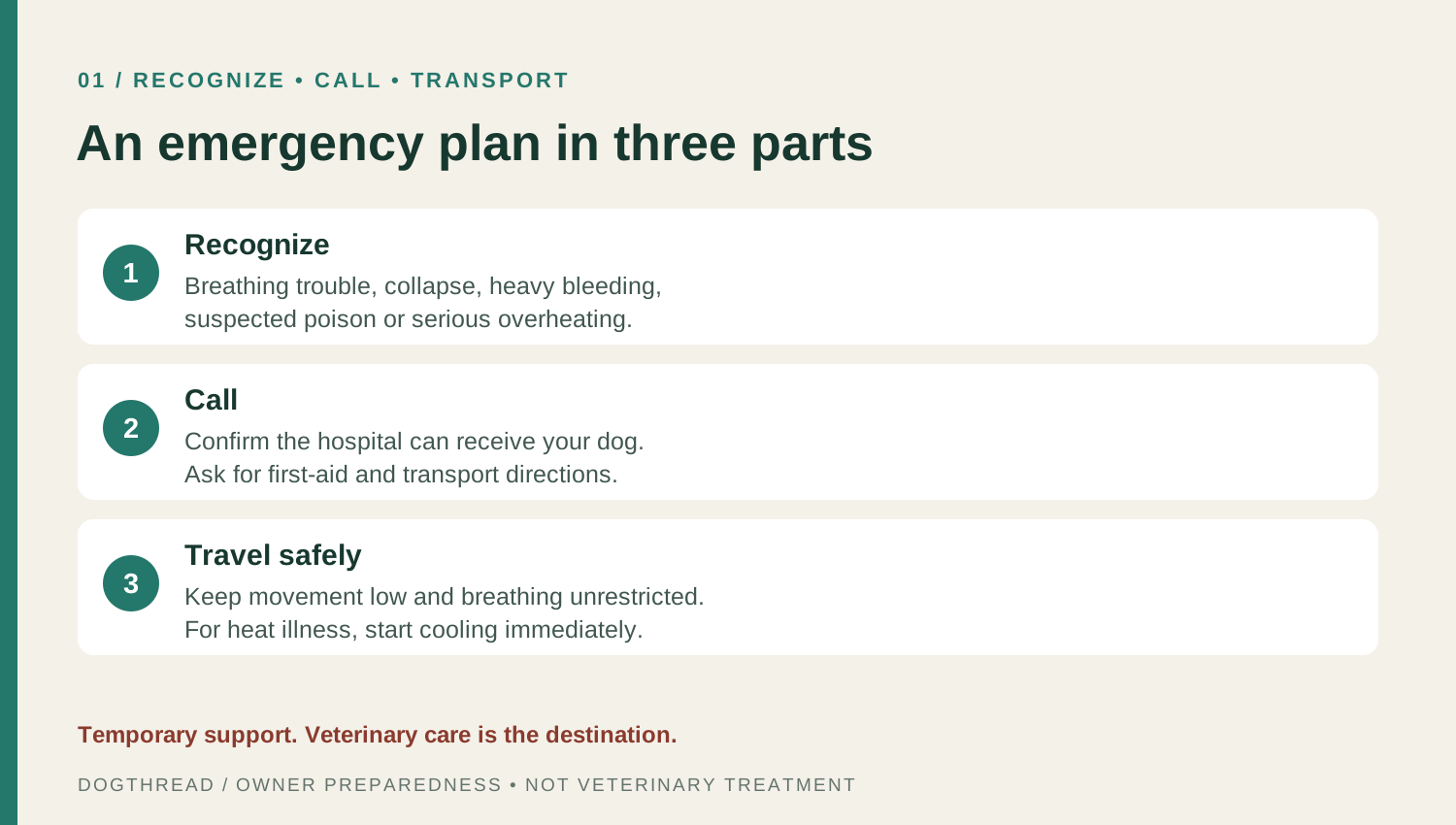
Arrange help and transport together. For suspected heatstroke, begin cooling immediately.
If another adult is available, divide jobs: one calls, one prepares the vehicle, and one stays with the dog. If alone, use speakerphone when safe. Do not handle your phone or attempt first aid while driving.
Protect yourself before handling an injured dog
Pain and fear can make a familiar dog bite. Approach quietly, keep children and other animals away, and keep your face away from the dog's head. Do not crowd, hug, or force handling.
Handler-safety rules:
- Check for traffic, electricity, smoke, chemicals, and other hazards before approaching.
- Wear gloves for blood or contaminants when available, without delaying urgent help.
- Keep fingers out of a conscious dog's mouth, including during apparent choking.
- Do not muzzle a dog that is struggling to breathe, overheated, vomiting, or unconscious. Never tie the mouth closed to make transport easier.
- For a dog that is alert and breathing comfortably but may bite, ask the clinic whether a familiar, properly fitted muzzle is appropriate. Do not struggle to apply one.
- If you cannot handle the dog safely, tell the emergency team and ask how to arrange assistance.
During a seizure, move nearby hazards away if safe, time the episode, and keep hands away from the mouth. Do not restrain the dog or try to pull out its tongue.
Routine familiarity with dog body language can help you notice distress, but an injured dog's behavior may be very different from normal.
Transport safely without making the injury worse
Keep movement and excitement low. A dog with breathing trouble should be allowed the position in which it breathes most comfortably; avoid squeezing the chest or neck.
For a small dog, remove a carrier's top if possible and gently lower the dog in rather than pushing it through a narrow door. For a larger dog or suspected spinal injury, ask for help and veterinary instructions before moving it. A rigid board may serve as a stretcher; move the body as a unit and avoid twisting. Do not force a dog to walk to prove it can.
Secure the carrier or supported dog against sliding, without straps pressing on injuries or restricting breathing. Ask the clinic to meet you with a stretcher if needed. Do not let an injured dog ride loose or in a driver's lap.
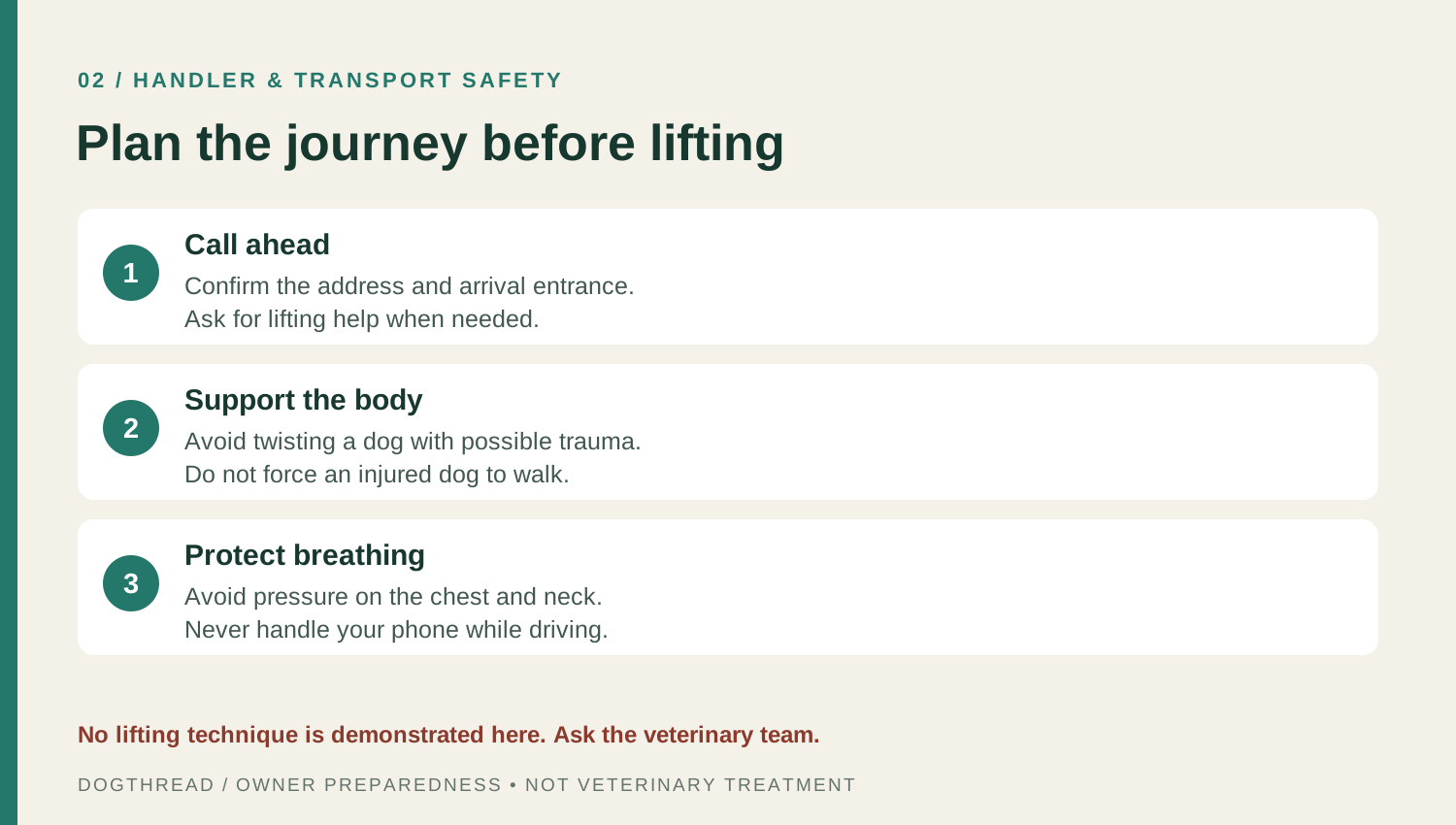
This is a planning aid, not a demonstration of lifting or spinal immobilization.
Do not try to straighten a fracture or improvise a tight splint. Do not give food, force water, or give human painkillers unless the veterinary team specifically instructs you. Protect an injured dog from cold where appropriate, but do not wrap an overheated dog in a blanket. Veterinary guidance on first aid and transport emphasizes minimizing movement and getting to hospital promptly.
Bleeding: apply direct pressure while arranging care
For an accessible external wound, place a clean absorbent pad, gauze, or cloth over it and hold steady direct pressure. Keep pressure in place rather than repeatedly lifting the pad to check. If blood soaks through, add clean material on top while continuing pressure and following the clinic's instructions.
Heavy bleeding is an emergency: call and travel to a veterinary hospital, with another adult maintaining pressure if possible. Pressure controls visible blood loss temporarily; it does not tell you whether internal injury is present.
Do not pull out an embedded object, probe a deep wound, or apply pressure to an injured eyeball. Do not use peroxide or alcohol in a wound. Avoid improvised tourniquets or tight circumferential bandages unless a veterinary professional gives specific directions; incorrect application can cause additional injury.
Small-looking punctures after a bite can conceal deeper damage. Arrange veterinary assessment rather than judging seriousness by the hole's size. VCA's emergency guidance supports direct pressure and urgent assessment for significant or persistent bleeding.
Heat illness: start cooling immediately and get veterinary help
Suspect heat illness when heat or exertion is followed by excessive panting, noisy breathing, drooling, distress, vomiting, weakness, confusion, or collapse. Do not wait for every sign, and do not delay cooling to find a thermometer.
- Stop activity and move the dog out of the heat into shade or an air-conditioned space.
- Start wetting the body with available water cooler than the dog, avoiding the face and airway. Room-temperature or cool tap water is a practical option; do not wait to obtain a special temperature.
- Add airflow with a fan or ventilation when available.
- Call the emergency vet immediately, describe what you see, and arrange prompt transport. Continue cooling safely during travel as directed. Do not wait for the dog to look fully recovered before leaving.
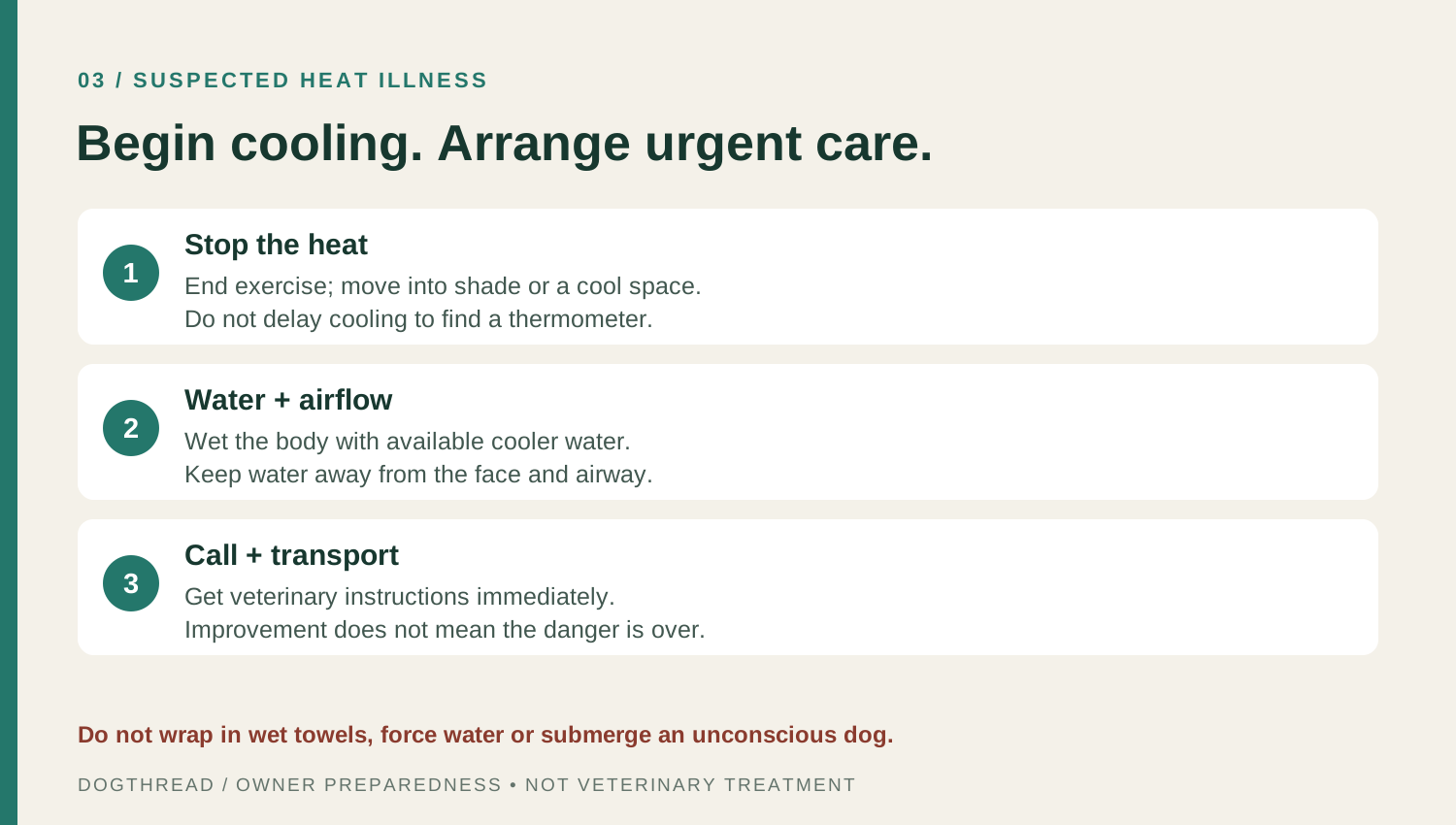
Cool first while arranging care. Keep water away from the face and airway.
Do not force drinking, cover the dog with wet towels that trap heat, or submerge an unconscious dog. Cooling methods need adjustment for age, health, and consciousness, so ask the vet for case-specific instructions.
The RSPCA's current heatstroke guidance stresses “cool first, transport second” and warns that delaying cooling is dangerous. This means start cooling now, not remain at home until every sign disappears. A dog that improves still needs veterinary evaluation. For prevention in short-muzzled dogs, see our French Bulldog heat safety guide.
Poisoning: call before giving anything
Move the dog away from the substance if you can do so safely. Prevent further licking or swallowing, protect yourself from chemicals, and contact a veterinarian or animal poison service immediately. Do not wait for symptoms.
Do not induce vomiting or give peroxide, salt, milk, oil, activated charcoal, food, or other home remedies unless a veterinary professional specifically directs you for this exposure. A remedy that sounds familiar can make a particular poisoning worse.
Keep the original packaging or take clear photographs of the label and ingredients. Record the likely amount, time, dog's weight, symptoms, and current medicines. Do not bring loose hazardous material into the car.
| Service | Telephone | Availability and fees | | --- | --- | --- | | ASPCA Poison Control | 888-426-4435 | 24/7; a consultation fee may apply | | Pet Poison Helpline | 855-764-7661 | 24/7; a per-incident consultation fee applies |
These North American services are not substitutes for an emergency hospital. Numbers and availability were checked on November 3, 2026. Outside their service area, use your local emergency veterinarian or regional animal poison service; check access before travelling.
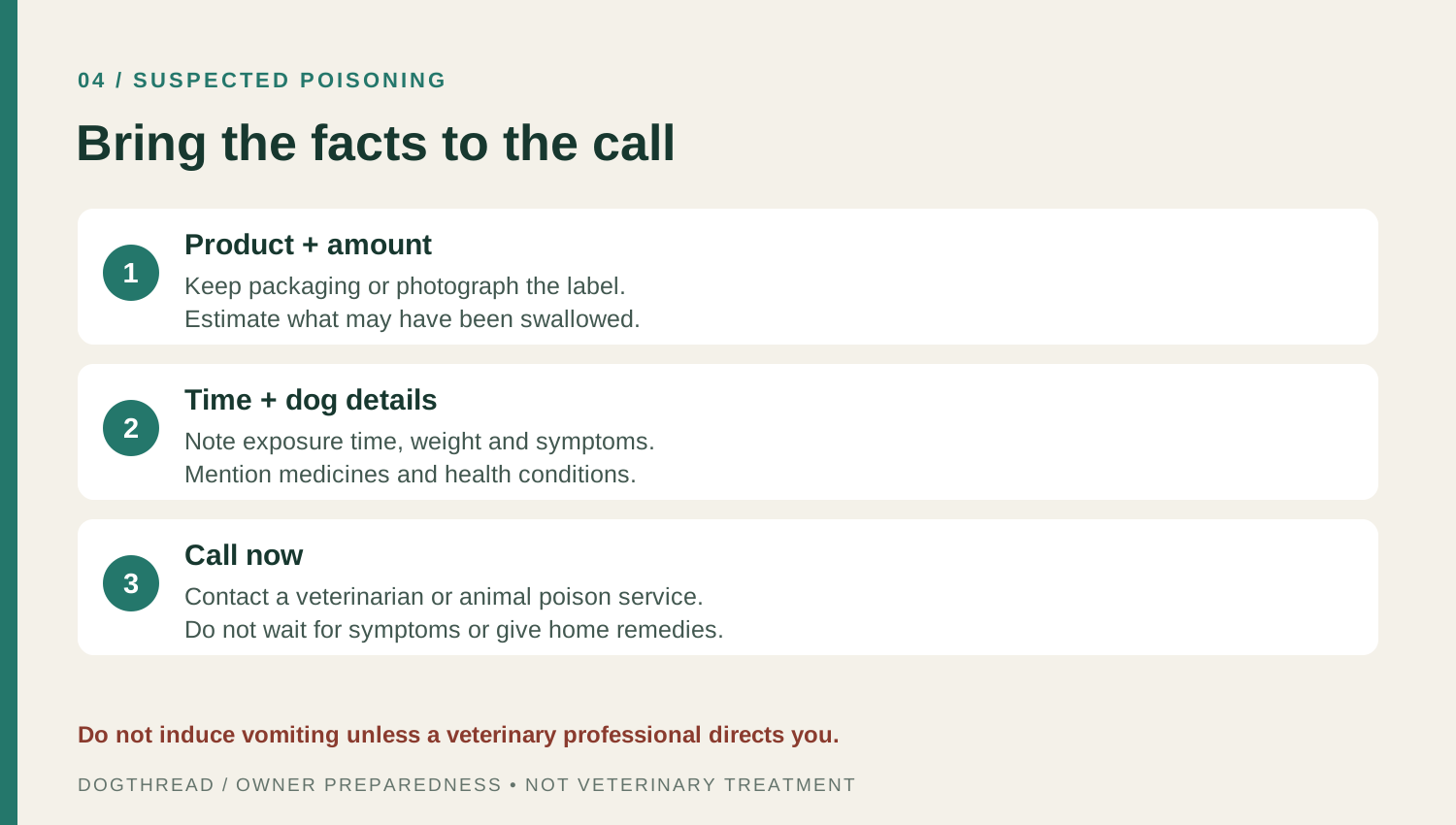
Gather the details while calling—not instead of calling.
If the dog is collapsed, seizing, or struggling to breathe, arrange emergency transport immediately and have another adult contact the poison service when possible. Ask the hospital how to coordinate the case. Pet Poison Helpline explicitly advises against home antidotes and inducing vomiting without professional consultation.
Choking and CPR: know the boundary before an emergency
Apparent choking, ineffective breathing, or collapse demands immediate veterinary help. Coughing, gagging, and airway obstruction can look similar to an owner; do not assume a dog needs abdominal thrusts merely because it is coughing.
Do not perform blind finger sweeps, push an object farther into the throat, or put your hands into a conscious dog's mouth. Call on speakerphone and describe consciousness, breathing, and anything visible without forcing the mouth open. If air is not moving, tell the team immediately so they can give real-time instructions. Do not spend time reading or watching a long tutorial.
CPR is for suspected cardiac arrest, not for an awake dog or one breathing normally. If a dog becomes unresponsive and is not breathing normally, including only gasping, state that clearly to the emergency team and seek immediate CPR direction. If trained, use your current pet-CPR training while someone else arranges urgent veterinary care. Do not delay action trying repeatedly to find a pulse you are not trained to assess.
This page intentionally does not provide a generic compression diagram, rescue-breathing recipe, or choking maneuver. Safe technique depends on assessment and the dog's body shape, and reading a paragraph is not a practical skills course. RECOVER offers pet-owner CPR education and hands-on certification pathways. Learn before you need it, and ask your vet which course suits your household.
Build a dog first-aid kit you can actually use
A useful pet first aid kit buys time for contact, safe handling, and basic support. It is not a miniature pharmacy. Store it where an adult can find it immediately and keep a smaller version for trips.
Printable packing checklist:
- [ ] Regular vet and 24-hour emergency hospital numbers, addresses, and backup hospital.
- [ ] Poison-service numbers and a paper emergency contact sheet.
- [ ] Dog's current weight, medical conditions, medicines, allergies, and microchip details.
- [ ] Disposable gloves, sterile gauze, absorbent pads, and non-stick dressings.
- [ ] Clean cloths and towels for pressure or handling; a blanket for support or warmth when appropriate—not heatstroke.
- [ ] Sterile saline suitable for basic rinsing; ask your vet how and when to use it.
- [ ] Blunt-ended scissors and medical tape; cohesive wrap only if your vet has shown you safe use.
- [ ] Spare lead, secure carrier, and an agreed transport plan for a dog too large to lift alone.
- [ ] A familiar, properly fitted muzzle only where appropriate, with the breathing/heat/vomiting warnings attached.
- [ ] Water, a bowl, a charged phone, power bank, and a small flashlight.
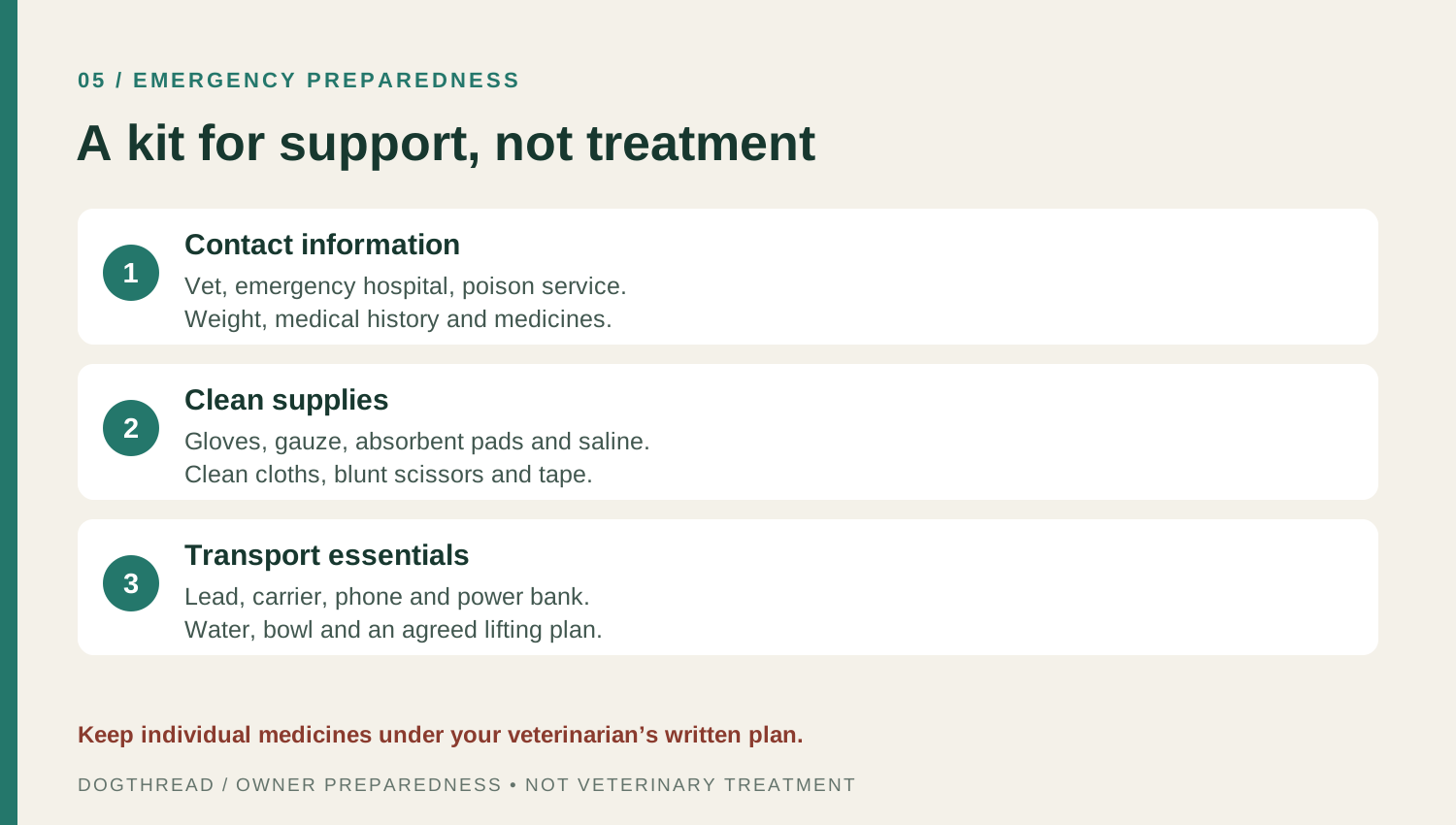
Useful supplies support the journey to care. Medicines require an individual veterinary plan.
Ask your veterinarian about any dog-specific additions, prescribed rescue medicines, their storage, and exactly when to use them. Do not add human painkillers or a bottle of peroxide as default “just in case” treatments.
Review the kit before trips and whenever medicines change. Replace expired or damaged supplies. Practise locating the emergency entrance and assembling the carrier without the dog being injured. If preparing for a new arrival, our puppy home checklist covers the wider setup.
Frequently asked questions
What should I do first in a dog emergency?
Check that the scene is safe, call an emergency veterinary hospital, and arrange safe transport. Describe consciousness, breathing, bleeding, and the suspected cause. For heat illness, begin cooling immediately while help is arranged.
Should I take my dog to the vet if first aid seems to work?
Yes after a serious emergency, even if the dog appears better. Cooling, pressure on a wound, or apparent recovery after a collapse does not rule out internal damage or complications. Ask the emergency team where and how quickly to attend.
Can I make my dog vomit after suspected poisoning?
Not unless a veterinarian or animal poison professional specifically tells you to for that exposure. Call immediately with the product details, amount, time, and dog's weight. Do not use home antidotes while waiting.
Should I wrap an overheated dog in a wet towel?
No. Wet the body with available cooler water, keep the face and airway clear, and add airflow while arranging veterinary care. Avoid coverings that trap heat; follow the emergency team's advice about continuing cooling during transport.
Can this guide teach me dog CPR?
No. It explains recognition and boundaries, not practical competence. Take pet-owner CPR training beforehand. In an actual collapse with absent or abnormal breathing, get immediate real-time instructions rather than delaying to study a guide.
Sources and update notes
This original editorial guide draws on publicly accessible veterinary and animal-welfare guidance for recognition, basic support, and escalation. No source or organization endorses Dogthread. Source checks completed November 3, 2026:
- VCA: Emergencies in Dogs—emergency signs, direct pressure, transport, and need for examination after apparent recovery.
- VCA: First Aid for Dogs—scene safety, handling, and transport principles; not used as a CPR technique tutorial.
- RSPCA: Heatstroke in dogs—immediate water cooling, airflow, and urgent veterinary care.
- ASPCA Poison Control and Pet Poison Helpline—current contact numbers, fees, and poisoning escalation.
- RECOVER: Pet owners and pet professionals—formal CPR education and certification pathway.
Recheck poison-service contact information and emergency guidance at each substantive update. For your own dog, an individual emergency plan from your veterinary team takes priority.