Dog of the Day: Greyhound
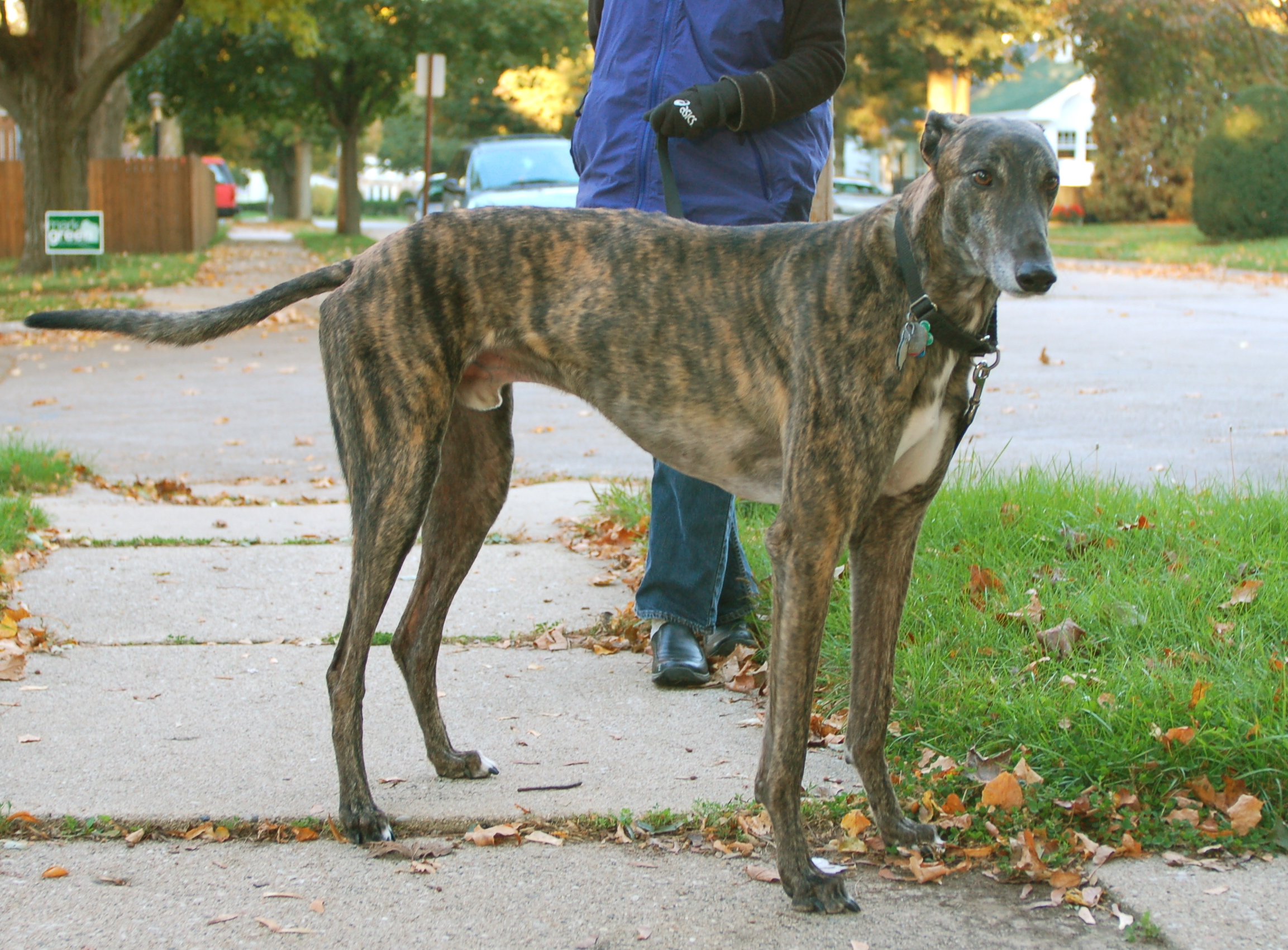
Legend, a brindle Greyhound. Photo: Scott Feldstein, via Wikimedia Commons, CC BY 2.0. Unmodified.
A Greyhound can look like an invitation to take up marathon running, then spend an impressive afternoon occupying a dog bed. Both the athlete and the lounger are real. This is a large sighthound built for fast pursuit, not a promise of endless stamina—or effortless pet ownership.
The Greyhound suits someone who wants a gentle, often restful companion and can provide daily walks, secure exercise, patient training, and thoughtful handling around smaller animals. It is a poor match for an owner whose plan depends on unrestricted off-leash freedom or guaranteed compatibility with cats. Individual temperament and history matter more than the sofa-dog nickname.
Greyhound quick facts
| Trait | What it means for an owner | | --- | --- | | Breed group | Hound; specifically a sighthound that pursues using vision | | Adult size | Large; the Greyhound Trust lists roughly 69–76 cm at the shoulder and 26–40 kg across females and males | | Build | Long legs, deep chest, narrow head, and a lean, muscular body | | Coat | Short and smooth; light grooming, but not a non-shedding coat | | Typical temperament | Often gentle, affectionate, sensitive, and independently minded; individuals vary | | Exercise pattern | Daily activity and enrichment, with sprinting ability distinct from endurance needs | | Biggest management issue | Fast pursuit of moving animals; security cannot depend on recall alone |
These size figures come from the Greyhound Trust breed profile, not a target weight for every dog. Ask a vet to assess your dog's body condition and health rather than feeding toward the middle of a chart.
A sighthound history written into the body
Greyhounds belong to the long history of dogs selected to see and pursue game. In coursing, the dog's speed and ability to make decisions during pursuit mattered: it could be running well ahead of the person handling it. The modern breed became closely associated with British coursing and, later, organized racing.
That purpose helps explain the combination of long limbs, powerful hindquarters, a deep chest, and an attention system that can suddenly prioritize movement. A narrow silhouette is not just a style. Nor is independence necessarily a refusal to cooperate; pursuit work rewarded a dog that could act without waiting for a fresh instruction every few strides.
Ancient art depicts sighthound-like dogs, but a similar outline does not establish an unbroken pedigree to today's Greyhound. You do not need a tidy ancient-origin legend to appreciate a breed whose working function is still so visible. Our guide to why dogs were bred for jobs, not aesthetics explores that wider connection.
Speed is not an all-day exercise prescription
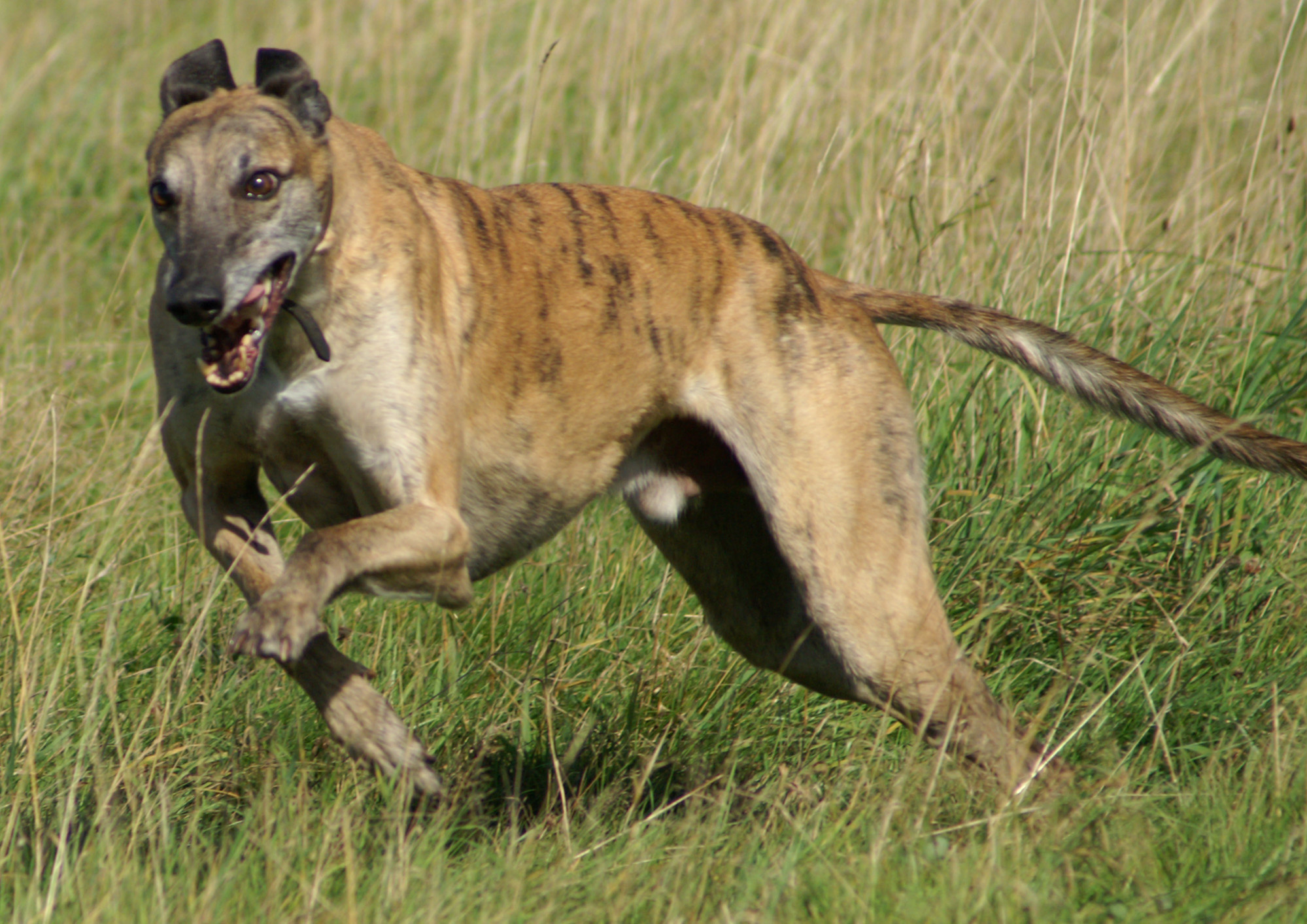
Moby running. Photo: Dave Hamster / David Merrett, via Wikimedia Commons, CC BY 2.0. Unmodified. The photograph does not establish whether the area is securely fenced.
Greyhounds are exceptional sprinters. That does not make every Greyhound an enthusiastic distance runner, and it does not mean a pet needs daily maximum-speed exertion to be content.
Published exercise guidance differs. The Greyhound Trust describes two twenty-minute walks as sufficient for many of the dogs it homes; PDSA's Greyhound guide suggests about an hour of daily exercise. Those are broad starting points from different organizations, not competing guarantees about your dog.
For a healthy adult, plan regular walks with opportunities to sniff, additional toilet outings, and some gentle learning or food-search activities. Adjust duration and intensity to age, current fitness, weather, medical history, and recovery. Puppies, older dogs, and dogs with injuries need their own plans. A newly adopted adult may need gradual conditioning rather than an immediate fitness challenge.
If appropriate for the individual, a secure running space can offer enjoyable freedom. Running is not compulsory, and exhaustion is not the goal. Do not turn an occasional burst of speed into a demand for long-distance jogging or repeated hard chases. Ask your vet before starting an unfamiliar strenuous activity.
Secure exercise: build the boundary before testing the recall
A Greyhound's recall is a useful trained skill, not a substitute for physical containment. Once a small animal triggers pursuit, the dog may accelerate beyond your ability to intervene.
Before using a supposedly enclosed field, inspect the entire boundary and entrance. Look for gaps, broken panels, insecure latches, and opportunities to jump or squeeze through. Ask the adoption organization what fencing is suitable for the particular dog; a field advertised as dog-friendly is not automatically Greyhound-secure.
On ordinary walks, use a fixed-length lead and properly fitted equipment that the dog cannot back out of. Ask an experienced rescue adviser or qualified professional to check the fit on that narrow head and deep-chested body. Do not assume equipment is escape-proof because of its label. Prevent access to open doors and gates at home, too.
Practice attention, name response, calm lead handling, and recall in safe settings using rewards. Our recall training guide explains how to build the behavior; it does not remove the need to manage chase risk. An unenclosed dog park is not a suitable place to discover whether your new dog has a strong prey drive.
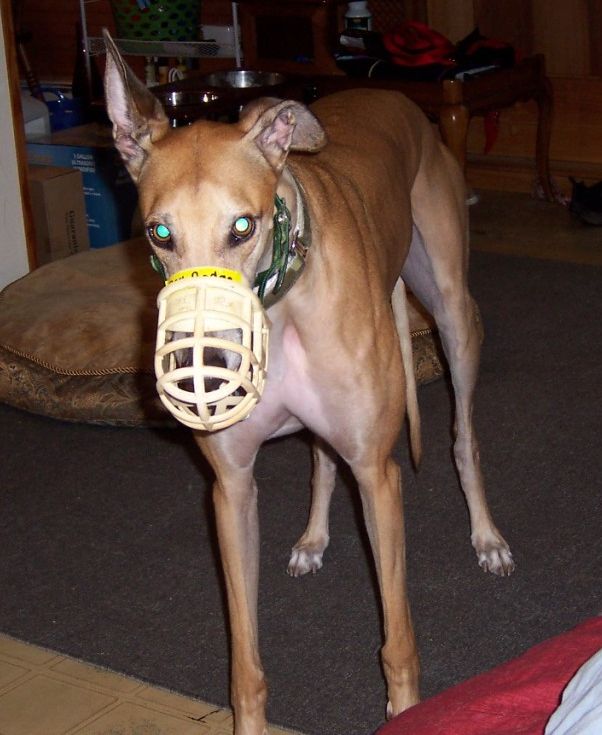
A Greyhound wearing a turnout muzzle. Photo: Chaoticfluffy, via Wikimedia Commons, CC BY-SA 3.0. Unmodified. This is an equipment example, not an endorsement of its fit for another dog.
A suitable, positively introduced basket muzzle may be part of an individual safety plan. It must allow appropriate panting and be fitted with professional guidance. A muzzle does not make chasing safe, replace a lead, or justify exposing a cat to a risky introduction. Check local requirements rather than assuming Greyhound muzzle rules are the same everywhere.
Home temperament: gentle is not the same as bombproof
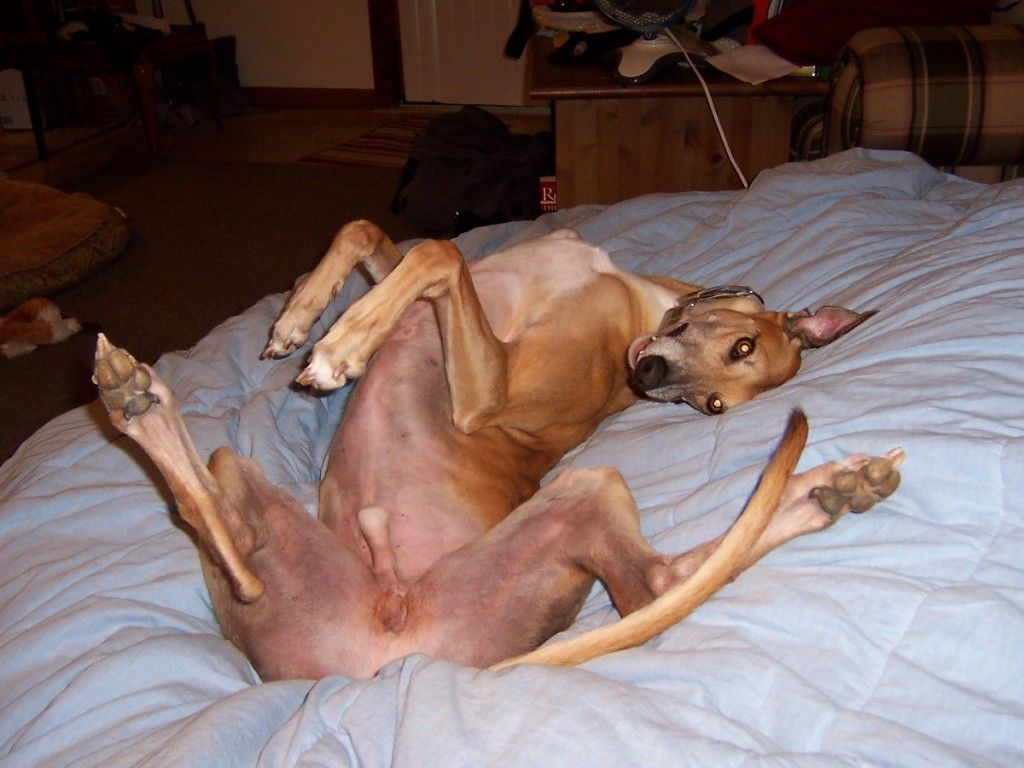
The upside-down resting position often called “roaching.” Photo: Chaoticfluffy, via Wikimedia Commons, CC BY-SA 3.0. Unmodified.
Many Greyhounds are affectionate without demanding constant activity. Some lean against a familiar person; others prefer companionship from the next bed over. Some are outgoing, while others need time and distance before greeting strangers. Neither shyness nor sociability can be read reliably from breed alone.
The famous upside-down sprawl is one of the breed's endearing quirks, not a requirement. A dog that rests differently is not failing to settle. Give it a quiet, comfortable place where nobody disturbs it while sleeping or eating.
With children, match the individual dog and supervise actively. Children need to respect resting spaces and avoid climbing on, cornering, or startling the dog. If an adult cannot supervise, separate safely. “Gentle breed” is not a childcare arrangement.
Apartment life can work when toilet access, walks, noise tolerance, and time alone all fit the dog. A large yard does not make up for missing companionship or inadequate care. Likewise, a dog that sleeps when you are home may still struggle when left alone. Introduce absences gradually and seek qualified help if distress appears. Start with the practical tradeoffs in our family-dog selection guide.
What about cats and small dogs?
Some Greyhounds live successfully with cats or smaller dogs; others should not. Discuss your actual household with the organization or breeder before committing. Ask what has been observed, with which animals, and in what setting. One calm encounter is not a lifetime safety certificate.
Use an individualized introduction and separation plan, with experienced support where needed. Familiarity with a household cat does not imply safety around unfamiliar cats outdoors. Rabbits and other small pets require equally serious consideration. Never stage a chase to “see what happens.”
Short coat, real body-care needs
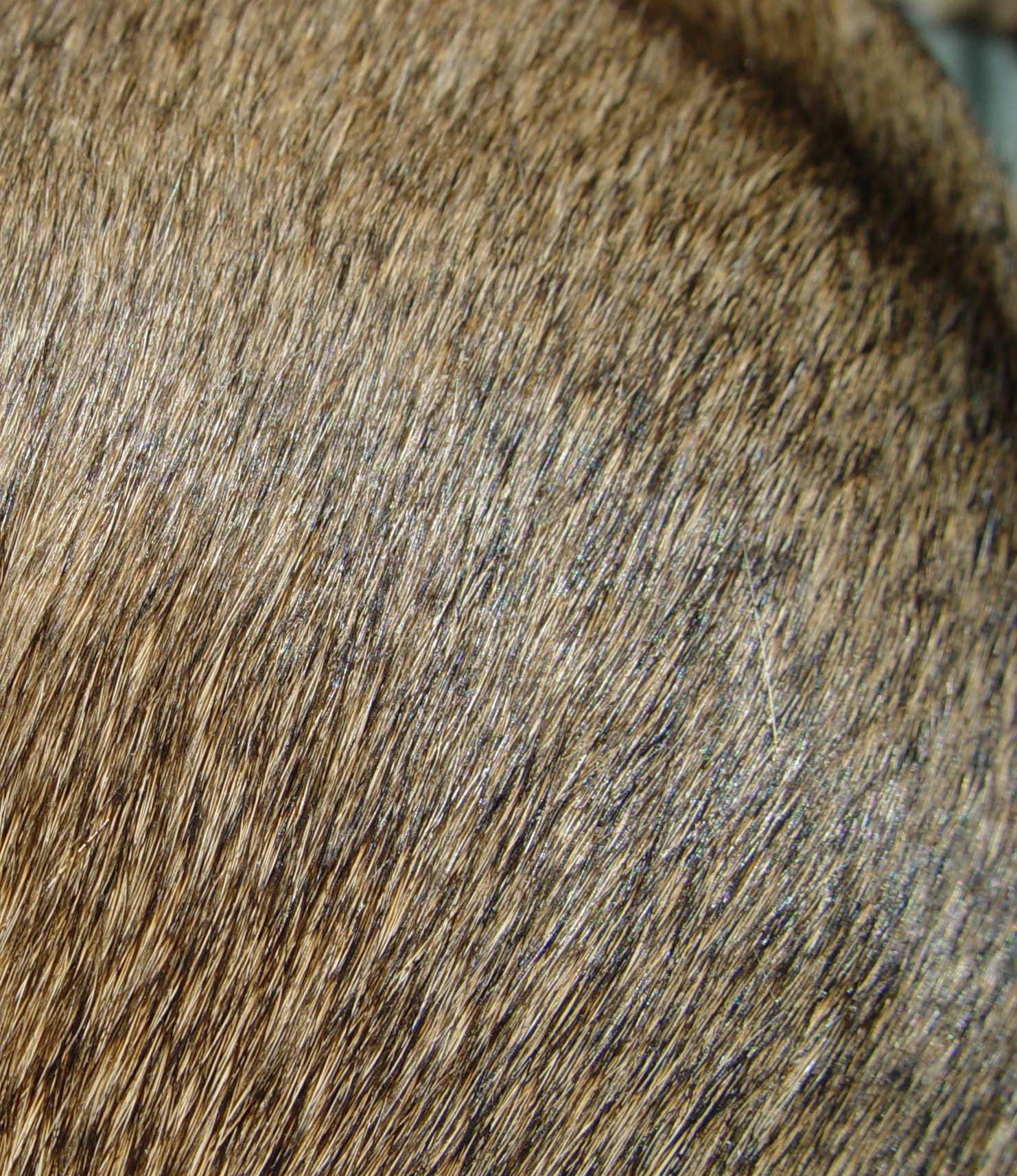
Brindle Greyhound coat detail. Photo: Scott Robinson, via Wikimedia Commons, CC BY 2.0. Unmodified.
Light grooming is a genuine advantage. PDSA recommends weekly grooming; use gentle tools and handling rather than treating the short coat as indestructible. Greyhounds still shed. Check skin, paws, nails, and any areas rubbed by equipment, and have painful changes examined rather than working around them indefinitely.
Their lean build and limited coat mean warmth and cushioning deserve attention. Provide supportive bedding and assess whether a properly fitted coat is needed in cold or wet conditions. Check underneath clothing for rubbing, and remove it if the dog becomes too warm. A coat is not protection from excessive heat or strenuous exercise in unsuitable weather.
Arrange a nutrition and body-condition discussion with your vet, especially after adoption or a major change in activity. Neither a very lean silhouette nor a racing background tells you how many calories this individual needs now. Do not automatically feed a resting pet as though it were in active competition.
Dental care also belongs in the routine. Introduce dog-safe toothbrushing gradually if tolerated, and ask your vet about examination and cleaning needs. The dog dental care guide explains why a chew alone is not a complete dental plan.
Adoption: meet a dog, not a ready-made backstory
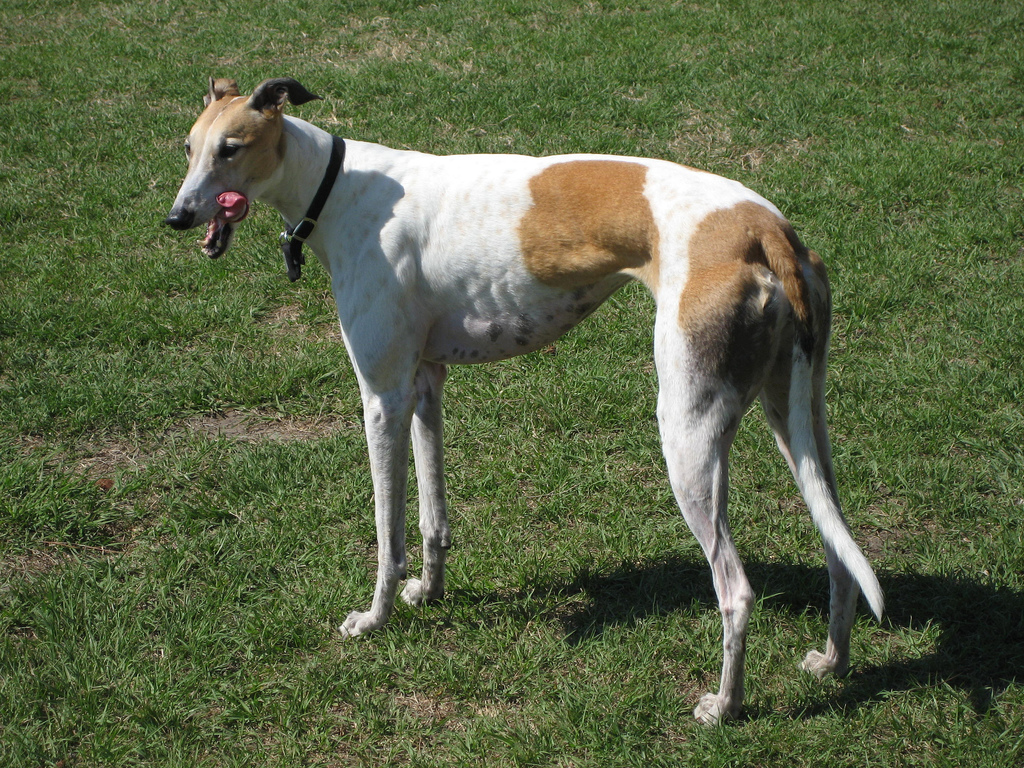
Grace, photographed at four years old. Photo: Neurodoc, via Wikimedia Commons, CC BY-SA 3.0. Unmodified. Her appearance here does not imply adoption availability or a racing history.
Greyhound adoption organizations often place dogs after racing, but not every Greyhound has raced, and racing histories are not interchangeable. Do not assume that a retired racer was mistreated, has never met a child, is already house-trained, or will immediately understand a household routine. Ask for the information available about that particular dog, including what remains unknown.
Useful questions include:
- What has been observed around other dogs, cats, children, food, handling, and resting spaces?
- Has the dog lived in a home or foster setting, and what was that setting like?
- What is known about time alone, toilet habits, stairs, slippery floors, and car travel?
- Are there previous injuries, current medications, dental needs, or activity restrictions?
- What matching, follow-up support, and return arrangements does the organization provide?
Keep early routines predictable and introductions manageable. Teach unfamiliar household skills in small steps; do not drag a hesitant dog up stairs or force it through a frightening situation. Travel preparation matters too: choose a properly fitted restraint or suitable secured crate rather than letting a tall dog move loose in the car. Our guide to dog car restraints and crash-test claims explains what to check.
The Greyhound Trust care and training resources include support for training, separation difficulties, and introductions to small animals. Ask your local organization for guidance specific to the dog you are adopting.
Health planning before an urgent problem
Arrange an initial veterinary visit and take the available records. PDSA identifies dental disease, gastric dilatation-volvulus (GDV), and osteosarcoma among health concerns relevant to Greyhounds. These are planning considerations, not predictions that every Greyhound will develop them.
Discuss dental health, any persistent lameness or foot pain, previous injuries, nutrition, routine prevention, and an appropriate exercise plan. For a puppy, ask about documented parental screening and family medical history; for an adult, request existing examinations and treatment records. Budget for both routine care and unexpected illness, and compare insurance exclusions carefully.
Repeated unsuccessful attempts to vomit, sudden restlessness, a swollen abdomen, breathing difficulty, or collapse warrant immediate contact with an emergency vet. PDSA's GDV guidance warns that swelling may not be obvious and that waiting can be dangerous. Do not wait for every sign to appear or try home treatment.
This feature is general owner education, not an individual diagnosis or treatment plan. Use your vet for medical decisions and a qualified, reward-based behavior professional when safety or distress needs individual assessment.
Is a Greyhound the right dog for you?
The strongest fit is a household that enjoys daily walks and a quieter indoor companion, accepts lead-and-fence management, and has room in its budget for a large dog's care. Willingness to learn the individual dog's habits matters more than owning a particular type of home.
Pause if you need a guaranteed jogging partner, a dog that can roam unfenced, immediate ease with small pets, or a companion that can simply be left alone for long stretches from day one. None of those expectations is made safe by the phrase “retired athlete.”
Choose the Greyhound whose needs match the life you can offer. The long nose and elegant stride are the introduction. The daily routine is the relationship.
Frequently asked questions
Do Greyhounds need lots of exercise?
They need daily walks, toilet opportunities, enrichment, and an individual activity plan, but sprinting ability does not equal all-day stamina. Published guidance varies from two twenty-minute walks for many adopted adults to about an hour daily. Adjust with your vet and adoption adviser rather than treating either figure as universal.
Are Greyhounds good family dogs?
Many are gentle, affectionate companions. Suitability depends on the individual dog's history and behavior, children's ability to respect boundaries, and consistent adult supervision. No breed label guarantees safety with children.
Can a Greyhound live with cats?
Some can, but some cannot safely do so. Discuss actual observations and your household with the adoption organization before committing, then follow an individual introduction and separation plan. Living peacefully with one cat does not establish safety with all cats or small animals.
Can Greyhounds be trusted off leash?
Do not depend on recall in unenclosed places. Their pursuit instinct and speed can overwhelm even a practiced response. Use a lead outside and inspect a genuinely secure enclosure before allowing free running where appropriate.
Do Greyhounds shed or need winter coats?
They shed despite having a short coat, and usually need only light grooming. Some need a well-fitted coat in cold or wet weather, depending on conditions and the individual. Monitor comfort and avoid overheating.
Are all adoptable Greyhounds retired racers?
No. Dogs reach adoption through different routes, and even racing backgrounds vary. Ask for records and observed behavior rather than assuming a shared history or a fixed adjustment timeline.
Sources and editorial approach
Reviewed November 2, 2026. This is a source-based breed feature, not a report of hands-on breed testing or veterinary review. Exercise figures are presented with their source differences, and historical discussion avoids treating ancient depictions as proof of a modern pedigree.
- American Kennel Club: Greyhound breed profile — breed identity and broad temperament context.
- American Kennel Club: Greyhound facts — pursuit history, speed, independence, and home temperament; broad ancient-lineage and animal-speed comparisons are not repeated here.
- Greyhound Trust: All About Greyhounds — size, walking guidance, individual matching, and small-animal cautions.
- Greyhound Trust: Care and Training — adoption support and training resources.
- PDSA: Greyhound — grooming, exercise guidance, and health considerations.
- PDSA: GDV in dogs — emergency signs and need for urgent veterinary care.
Photographs are licensed source images of Greyhounds, not dogs assessed by Dogthread. Credits and license links accompany each image; depicted settings do not certify a safety setup, temperament, or medical condition.